
Performance marketing has crossed a pivotal line. Marketers are no longer just using artificial intelligence (AI) to inform decisions, but deploying AI systems that make decisions in real time, autonomously, without waiting for a human to sign off. The shift from manual campaign management to always-on autonomous operation has already happened.
According to a new survey of 200 senior performance marketers conducted by Realize in March 2026, Google PMax has reached 91% adoption at scale, while Meta Advantage+ sits at 88%. Those are not early-adopter numbers, that’s almost the whole industry. Meanwhile, everything else, like TikTok Smart+, the open web, and every channel outside those two, is still in testing or beta mode.
The Agentic Advantage in Performance Marketing Report 2026
This isn’t a story about where AI is going, but one about a transformation that has already taken place in search and social, and is now working its way across the rest of the marketing map.
From Automation to Autonomy: What “Agentic” Actually Means in Practice
The word “agentic” is often used loosely, so let’s be clear about what it means in reality. Traditional performance marketing automation executes instructions a human already set. You define the audience, set the bid cap, decide when to run and when to pause. The system follows the rules you wrote. The decisions are still yours, just made in advance.
Agentic AI works differently. You set a goal, like a target cost per acquisition (CPA) or a return on ad spend (ROAS) threshold, and the system figures out how to get there. It reads performance signals in real time and adjusts continuously without waiting for a human to intervene. As the report describes the process, these are systems that continuously execute strategies and optimize performance in real time.
For performance marketers, this changes the nature of the job. The role shifts from managing campaigns day-to-day to setting the conditions for the system to manage them well as an autonomous strategist. That’s still skilled work, but it’s a different kind of skilled work, and it’s already the reality for most teams running search and social.
When the system is making real-time decisions about audiences, placements, bids, and creative combinations, the marketer is no longer the one deciding upon those variables directly. That’s a change in how accountability works, and it requires a different relationship with data, with campaign goals, and with the platforms themselves. Getting clear on what you’re optimizing toward matters more than it ever did, because the machine will optimize toward exactly what you tell it to.
The Shift from “Set It” to “Set the Goal”
Not long ago, a performance marketer’s week included pulling reports, identifying audiences that weren’t converting, adjusting bids by segment, rotating creatives, monitoring pacing, and checking placements. Every one of those tasks required time and hands-on manual work or, at best, rules-based updates.
In channels where AI campaign management has scaled, most of that work no longer falls to the marketer. You give Google PMax a target CPA and a budget, and upload your creative assets and product feed. The system handles audience selection, bid levels, placement decisions, and creative combinations. The marketer’s focus becomes defining the goal, providing quality inputs, and knowing when to step in if something looks off.
The Google/Meta Blueprint: Why Mass Adoption Happened Fast
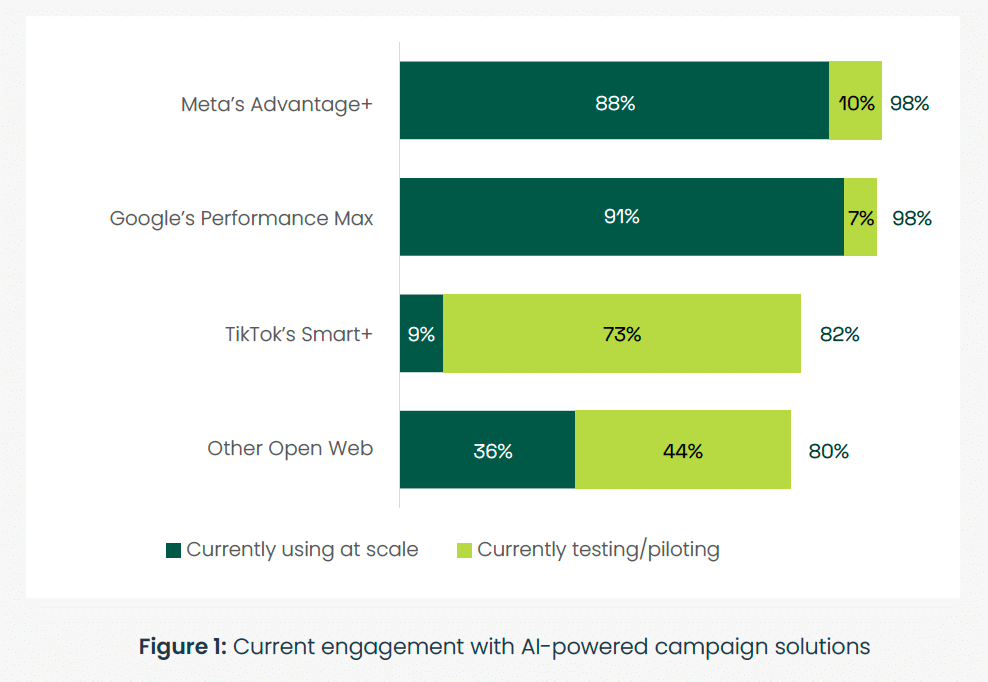
The adoption numbers for autonomous advertising on Google and Meta are difficult to overstate. Again, 91% of respondents running Google PMax and 88% running Meta Advantage+ at scale doesn’t describe a trend, but instead captures the new default operating model of the industry. Most new advertising technologies take years to reach anything close to majority adoption, but that wasn’t the case with agentic AI.
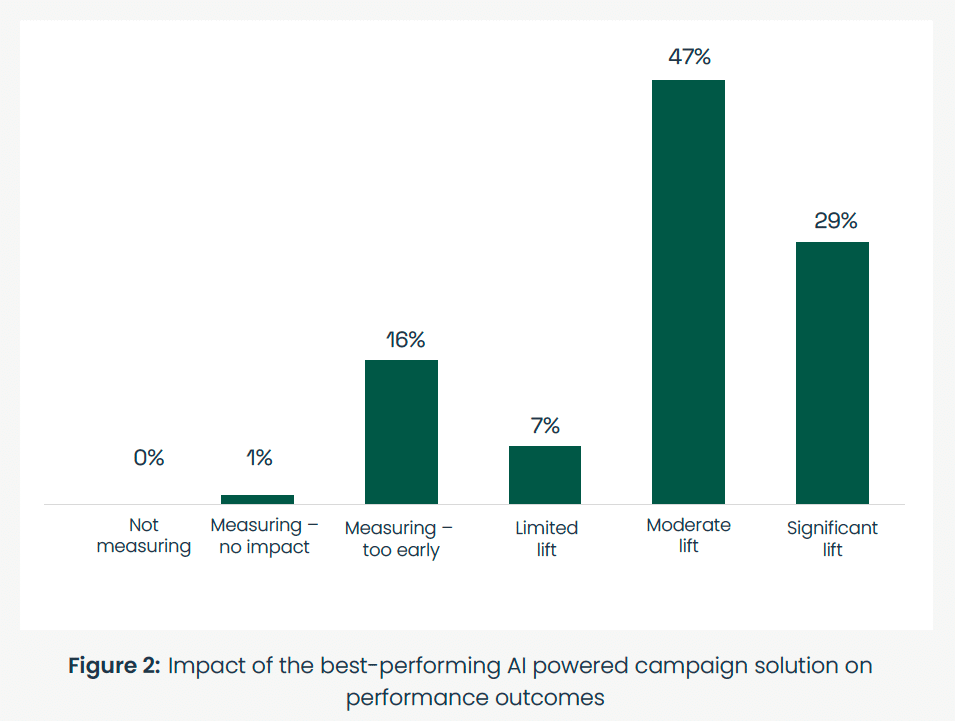
Why? Performance. When enough marketers ran these tools alongside their manually-managed campaigns and saw better results with less operational overhead, increased budget followed. The survey found that 76% of respondents report moderate to significant performance lift from AI-powered solutions such as PMax and Advantage+, with 29% describing that lift as significant. Adoption at this scale only happens when the proof is in the data.
It’s also worth noting that Google and Meta had structural advantages that made this easier to demonstrate. First-party data at scale, closed-loop attribution, and platform-controlled inventory meant these platforms could measure what was working and optimize toward it with confidence. That helps explain why bringing the same approach to other channels is harder, and why the rest of the industry is still working to catch up.
What Mass Adoption Looks Like in the Data
The survey data makes this two-tier reality very clear. Google and Meta are in a category of their own. TikTok Smart+, the next most widely engaged platform, is being tested by 73% of respondents but runs at scale by only 9%. Open web campaign solutions show 36% at scale, with 44% in active pilots.
Wide testing and scaled adoption are not the same thing. When 91% of an industry is running something at scale, that’s the default. When 73% are testing something with 9% at scale, the breakthrough hasn’t happened yet, even if the direction is clear.
Budget tends to follow proof, and proof takes time to accumulate in new channels. The concentration of scaled adoption in just two platforms means that for most performance marketing programs, the autonomous optimization capabilities that now define best practice are only being applied to a portion of total spend. The rest of the budget — in TikTok, on the open web, in connected TV (CTV), in retail media — is still largely managed the traditional way. That’s the opportunity that the next phase of agentic adoption is moving toward.
The Proof That Unlocked the Budgets
The budget-shift cycle with PMax and Advantage+ is simple and repeated: performance improved, budgets were pulled from manually-managed campaigns to agentic campaigns, further improvements were seen, and adoption continued to scale. Right now, that’s what’s missing from other advertising channels.
Of the 76% of respondents seeing meaningful improvement from AI-powered solutions, 29% describe it as significant and 47% as moderate. Only 7% report limited lift. One percent report no impact. Zero percent say they are not measuring at all. The 17% who say it’s too early to determine impact is worth noting, too: that’s not a sign of failure, but it does reflect how long real performance proof cycles take. It also suggests the current 76% figure has room to grow as measurement matures.
The top perceived benefit of these solutions, cited by 41% of respondents, is real-time optimization toward CPA and ROAS goals. These performance gains are not random; they come directly from systems that can process more signals and make faster adjustments than any human campaign manager can.
Where the Market Is Heading: TikTok, the Open Web, and Beyond
The history of agentic adoption in search and social gives a useful frame of reference for reading where other channels are right now. PMax and Advantage+ didn’t go from launch to near-universal adoption overnight. There was a period of wide testing, limited scale, and accumulating proof, then the results justified the budget, and scale followed quickly. That pattern is visible in the current data for the channels that come next.
TikTok Smart+ is the clearest near-term signal. Seventy-three percent of respondents are currently testing it, with only 9% running it at scale. That specific combination — broad organizational commitment to testing and limited scaled deployment — is what the PMax and Advantage+ adoption curves looked like initially.
The open web tells a more complex version of the same story. Forty-four percent of respondents are in active pilots, 36% are already at scale, and 82% see AI-powered goal-based buying there as a meaningful growth opportunity. The demand signal is strong and consistent across the data, but the gap between belief and scaled action is wider than it was for TikTok, and the reason is structural.
Google and Meta had closed-loop attribution, first-party data at scale, and platform-controlled inventory. Those advantages made it straightforward to demonstrate that autonomous optimization was working. The open web doesn’t have those same conditions built in, which means proving performance is harder and managing campaigns at scale is more complex.
TikTok Smart+: The Next Wave Taking Shape
The 73% testing figure for TikTok Smart+ carries real weight. Testing at that level requires budget allocation, operational bandwidth, and organizational buy-in. When almost three-quarters of senior performance marketers are actively piloting a platform, the question of whether agentic adoption will happen there is largely answered.
If performance proof for TikTok Smart+ starts replicating what PMax and Advantage+ have shown, the conversion from widespread testing to scaled adoption could happen quickly. That’s the pattern the industry has already shown it follows. What makes TikTok an interesting near-term signal is the gap between the testing number and the scale number. A 73% to 9% split looks like a platform that has the attention of almost the entire market, but hasn’t yet produced the consistent performance results that would justify moving significant budget.
The Open Web: Biggest Opportunity, Biggest Gap
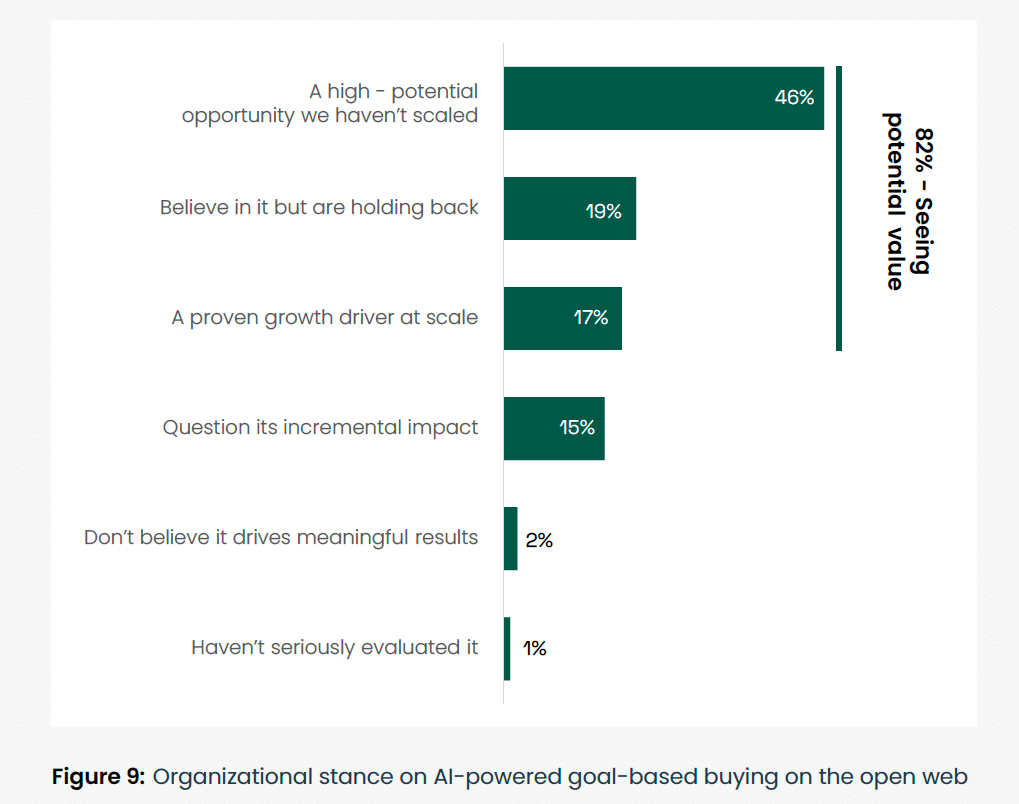
The open web is where the most significant tension in this data sits. The demand signal is strong: 82% of respondents view AI-powered goal-based buying on the open web as a meaningful growth opportunity. Seventy-five percent of marketers surveyed rate finding a performance channel delivering incremental outcomes beyond search and social as very or extremely important. Among the highest spenders, those at $5 million or more per month, 70% call it extremely important.
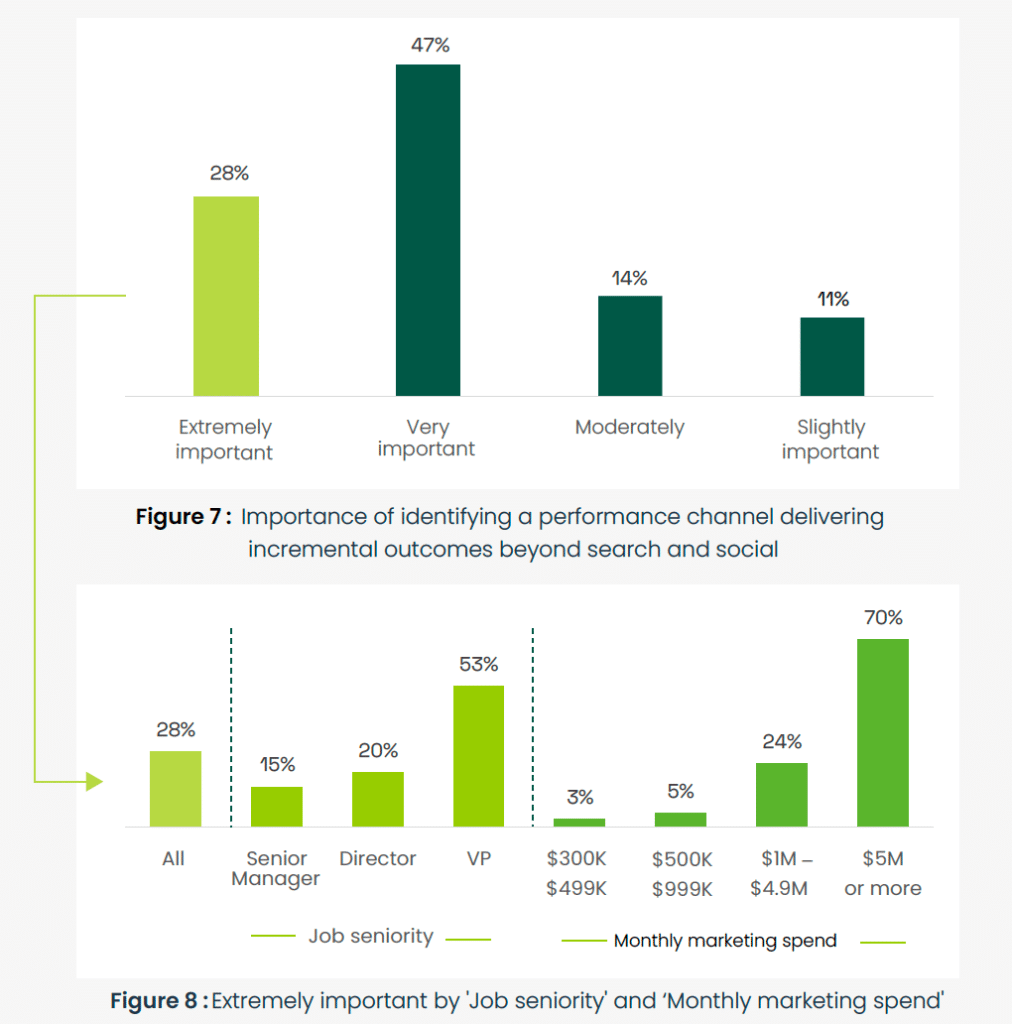
The urgency also increases with seniority. Among vice presidents (VPs), 53% rate finding an incremental performance channel beyond search and social as extremely important, compared to 20% of directors and 15% of senior managers. The push to diversify beyond walled gardens is seen most at the level where budget decisions get made. That’s a meaningful signal about where organizational priority sits, even when the investment data doesn’t yet reflect it.
Only 4% of companies currently put significant budget (25% or more of performance spend) into the open web. Most maintain a moderate presence. The channel accounts for an average of 13% of total performance marketing budgets today. That gap between recognition and investment reflects something specific about where the open web sits in the current ecosystem.
It’s not that marketers don’t believe the channel can work. It’s that the tools required to make it work at scale don’t yet exist at the same level of maturity for the open web. Marketers are being asked to manage something complex manually that, in other channels, the machine handles automatically.
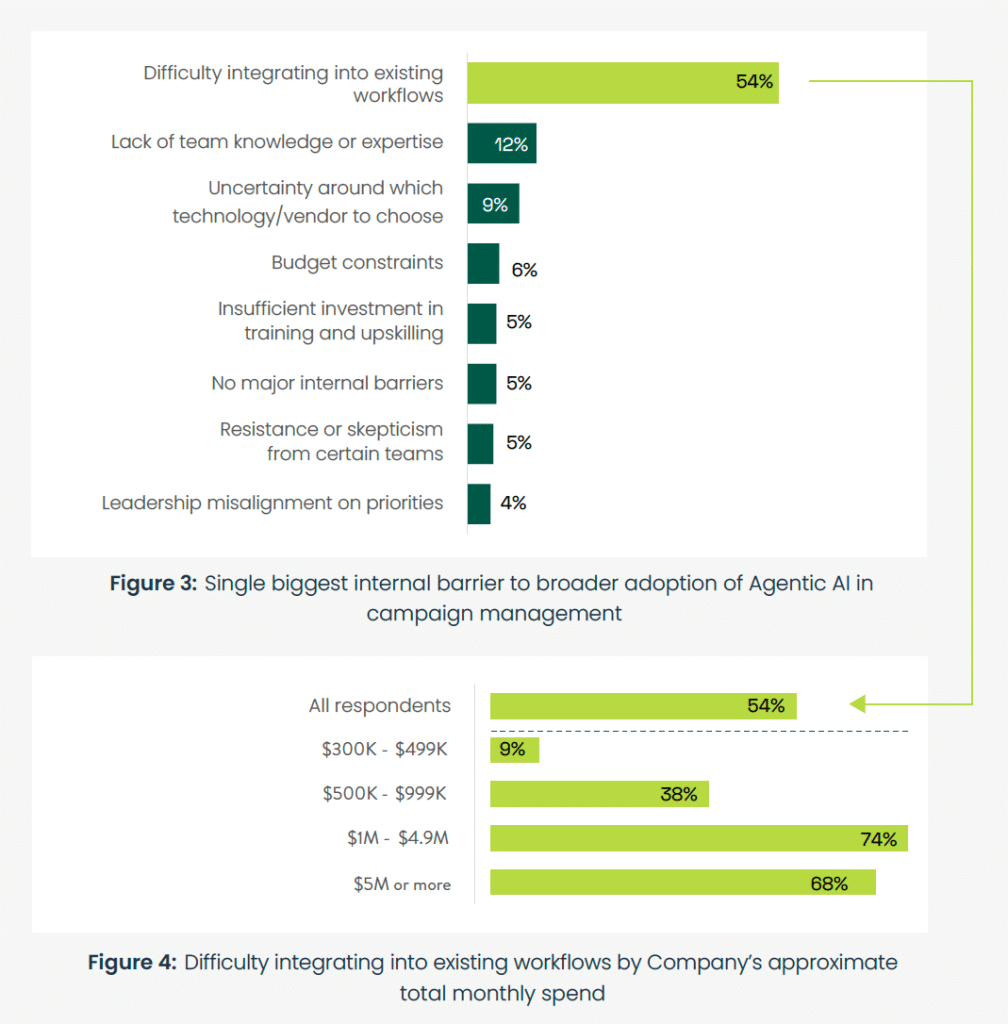
The barriers cited in the survey are almost entirely operational: 74% point to too many vendors and the complexity of managing multiple partners, 71% cite lack of unified attribution and measurement, and 54% flag brand safety concerns. These are infrastructure problems, not belief problems. Very few respondents question whether the open web can deliver incremental value. They are held back by the difficulty of proving it and managing it at scale.
This is exactly the situation that existed in search and social before agentic solutions arrived. The platforms that solved the measurement problem unlocked the budgets. The open web uses the same automated, goal-based buying tools that make performance proof achievable and operational complexity manageable.
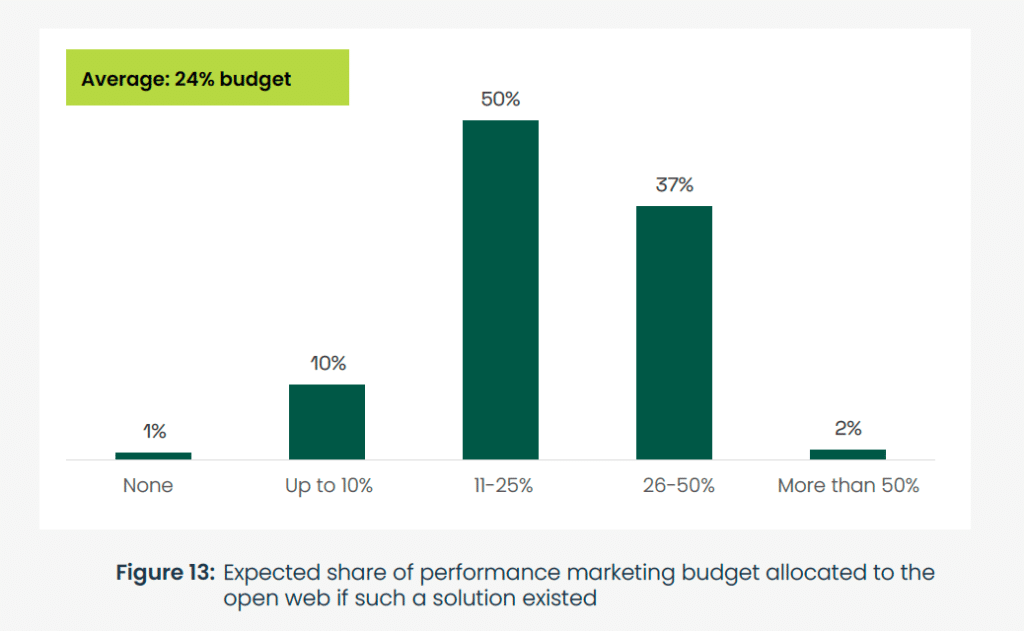
The survey data suggests the market is ready for that solution. Ninety-nine percent of respondents said they would allocate open web budget if agentic AI-powered solutions were available, with an average expected allocation of 24% of total performance spend. Seventy-four percent of $5 million or more spenders strongly agree they would increase open web investment if it offered the same automated campaign solutions available in search and social. The market is waiting for the infrastructure to catch up with the intent.
So What’s Next?
Agentic AI has already redefined what performance marketing means in search and social. It has proved, at scale and in account data, that autonomous optimization outperforms human campaign management when the infrastructure is right.
The remaining question is not whether this model extends further. Marketers want it to and they will direct their budget toward it when it arrives. The question now is about timing and readiness. The marketers who are building toward agentic capability on the open web by running pilots, establishing measurement foundations, and learning how autonomous optimization behaves outside walled gardens will be ahead of the shift when it lands, not racing to catch up with it.


