
- The Gap Between Now and Next: Why the Open Web Is Underinvested Relative to Its Potential
- The Demand Signal: What 81% of Marketers Are Telling Us About Readiness
- Who Leads the Shift: Why the Biggest Spenders and Most Senior Leaders Are Ready
- The Three Barriers: Vendor Complexity, Measurement, and Brand Safety
- The Budget Roadmap: From 4% to 24% and Beyond
- The Roadmap Is Drawn: Timing Is the Only Variable
If you look at the current data, you’ll see that it both describes where budgets sit today, and predicts where they’re going. That data-informed roadmap has a few new features, too, including agentic AI. What was once a nice-to-have experiment is becoming the primary engine driving the reallocation of performance spend on open web advertising. If marketers want to position their companies at the head of the pack, they need a copy of that map as the shift happens.
The Gap Between Now and Next: Why the Open Web Is Underinvested Relative to Its Potential
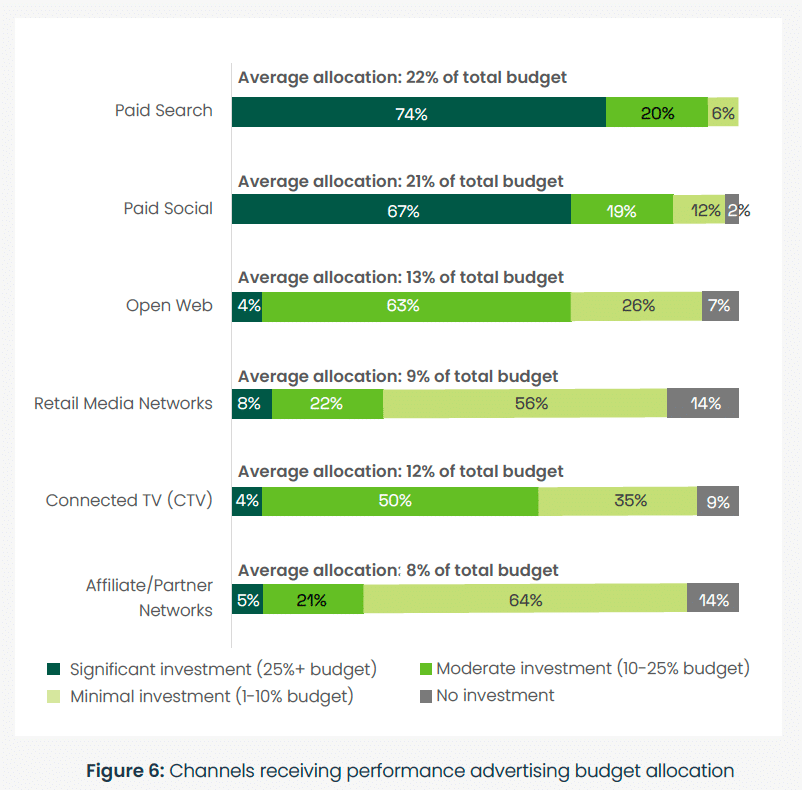
As a recent survey conducted by Taboola shows, there’s a pretty big disconnect between current investment and future intent. Currently, the open web — the expanse of premium publishers, news sites, and niche content hubs that comprise the internet — is a second thought for many organizations. Per the survey, only 4% invest significantly (think: 25% of their budget) in the open web, which currently accounts for about 13% of performance spread.
The Agentic Advantage in Performance Marketing Report 2026
Despite this, 82% of those same organizations describe AI-powered, goal-based buying on the open web as a meaningful growth opportunity.
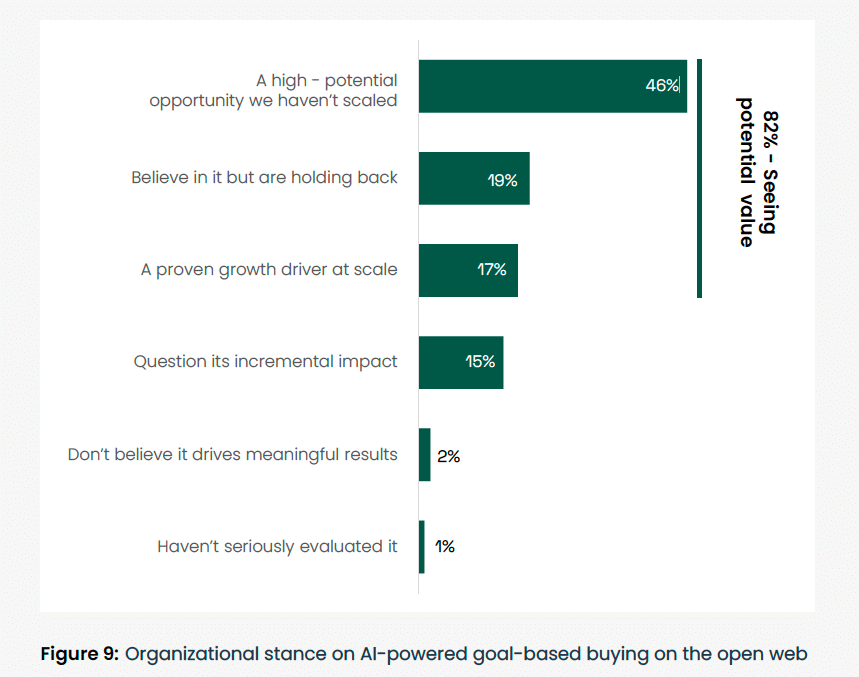
The gap between those numbers (13% actual allocation versus 82% belief in that potential) forms the premise of the future. The open web is the world’s largest advertising environment by inventory, reaching audiences at a scale dwarfing individual walled gardens. Yet, it commands only a fraction of objectively smaller platforms.
So, why the 13% average allocation? It’s not because the audience isn’t there — you can actually credit (or blame) an infrastructure lag. Search and social won the budget wars because they built the best machines — black-box, goal-based tools that made spending money easy and predictable. The open web’s always been there, but the tools for getting it to function well as a managed performance channel have been fragmented and manual. Marketers know the open web has value, but operationalizing the open web, with its multiple interfaces and supply paths, presents a major headache for the programmatic advertising future.
The Channel the Budgets Haven’t Caught Up With (Yet)
The open web offers something search and social can’t: genuine incrementality. When you buy there, you reach someone consuming high-intent, vertical content.
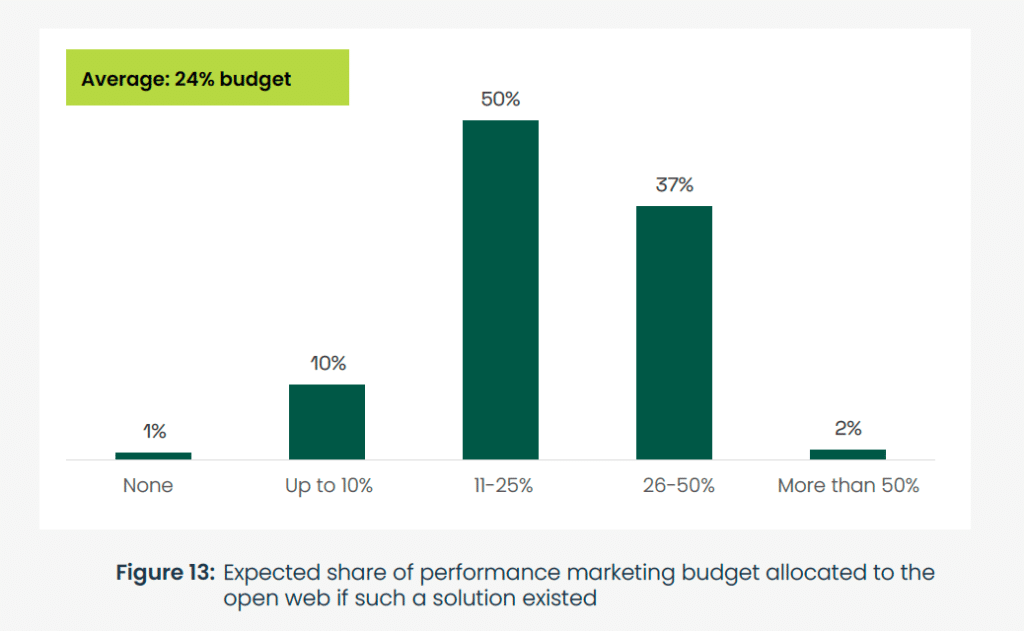
Interestingly, when you ask those same marketing teams about the future, the numbers flip. Nearly 100% of organizations say they’d shift budgets to the open web if an agentic AI open web solution existed to manage it. That’s an average expected allocation of 24%, with nearly 40% of marketers ready to shift a quarter of their total spend.
Talk about an opportunity — but also a missing product.
The Demand Signal: What 81% of Marketers Are Telling Us About Readiness
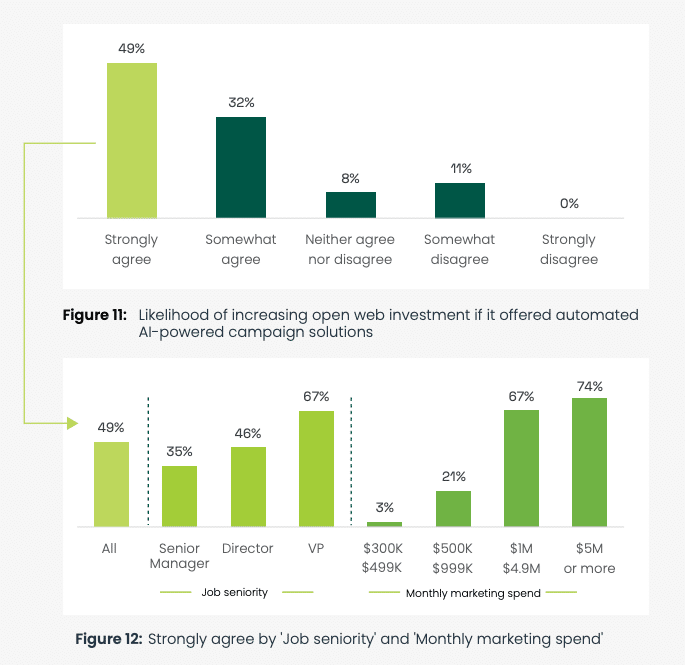
In performance marketing, where leaders scrutinize every dollar and ROI remains the number one metric, achieving 81% agreement on a hypothetical shift is rare. When you talk about the open web, though, over 80% of marketers say they’d increase their investment if it offered the same automated, AI-powered campaign solutions they currently use in search and social. That’s a seriously strong signal.
It’s nothing new, either. When agentic solutions became available and proved their value, marketing dedicated more budget to them. We saw this dynamic play out with tools like PMax and Advantage+. Once automation made the channel accessible and results defensible, budgets followed the path of least resistance. Optimizing your performance budget allocation for the open web is the next destination.
Strong Agreement vs. Somewhat Agree (and Why Intensity Matters)
If you examine that 81% more closely, you’ll see that nearly half (49%) “strongly agree.” These organizations have already decided in principle: they don’t need convincing that the open web works, they’re just waiting for the infrastructure to be finished.
Those 32% who “somewhat agree” represent the second wave — directionally aligned, but more cautious. They most likely want to see the first movers succeed before they commit and jump. This scenario creates a pretty familiar wave dynamic:
- The early adopters move.
- The results validate the model.
- The rest of the market follows in a surge.
Who Leads the Shift: Why the Biggest Spenders and Most Senior Leaders Are Ready
The driving force toward the open web? The biggest players in the room. The data shows a sharp increase in readiness as you climb the ladder of spend and seniority. Those who agree or strongly agree with shifting spend include:
- 35% of senior managers.
- 46% of directors.
- 67% of VPs.
If you break it down by spend, those who strongly agree include:
- 3% of those spending $300K-$499K.
- 21% of those spending $500K-$999K.
- 67% of those spending $1M-$4.9M.
- 74% of those spending over $5M.
This disparity exists because the biggest spenders hit the ceiling first. If you’re spending $10M monthly on social, you’ve likely found the point of diminishing returns already. With plateaued growth and CPAs creeping up, your CFO is asking why that extra million didn’t produce the same results. Those leaders are motivated to find a third leg of their performance stool and are the ones most likely to move the budget when they find it.
Why VPs Are the Catalyst and the Most Aligned
VPs often own the high-level strategy and hold the purse strings. They don’t need a committee to authorize a channel shift, but they do need a solution that works. When two thirds (67%) express this level of conviction, the conversation shifts from, “Should we commit?” to, “How fast can we execute?” They’re looking for ways to de-risk their portfolios and see the open web as a logical next step for scaling outside the currently dominant platforms.
The TL;DR: Those with the most authority to act are also those most ready to act.
The Three Barriers: Vendor Complexity, Measurement, and Brand Safety
If the intent is so high, then, what’s holding them back? The survey identifies a few specific operational hurdles:
- Too many vendors/complexity of managing multiple partners (74%).
- Lack of unified attribution and measurement (71%).
- Brand safety concerns (54%).
- Insufficient resources to manage additional channels (42%).
Here’s the thing: No one in the industry doubts the efficacy of the open web, but the operational requirements of managing it at scale feel insurmountable. Fortunately, it’s a solvable problem. Let’s look at the top three primary barriers identified by survey respondents in a bit more detail.
Vendor Complexity: The Fragmentation Problem
Nearly three quarters (74%) of marketers cite the sheer number of vendors as a primary barrier. To understand why it’s such a deterrent, look at the performance team’s daily reality. On one side, you have walled gardens with a single interface where you set a goal and a budget. On the other side, you have the open web, which is a maze of thousands of publishers, dozens of intermediaries, varying creative specs, and separate billing cycles.
Managing a campaign across even ten different publisher relationships creates a time-crushing amount of operational overhead. Each has its own trafficking system and reporting format. For lean teams that have built their workflows around automated tools like PMax or Advantage+, managing a fragmented open web buy is nightmare fuel — and a huge resource drain.
Bring on the consolidation. Performance marketers are asking for a single interface that uses agentic AI open web technology to handle the heavy lifting across all those fragmented sources. Automating the optimization and unifying the workflow banishes the operational nightmare and leaves the performance.
Unified Attribution: The Measurement Confidence Gap
Measurement is the technical barrier sitting under everything else. 71% of survey respondents are stuck here, and it’s a rational hesitation. Performance marketing, at its core, is a numbers game. If you can’t compare your open web CPA to your search CPA with 1:1 accuracy, how do you justify a $2M shift in spend?
This apples-to-apples gap (which is more like comparing apples to oranges) prevents confident allocation. The industry has plenty of data; what it really needs is a way to close the loop on attribution within a decentralized environment. Marketers want the same level of certainty in open web advertising that they’ve grown accustomed to in closed ecosystems.
It’s worth remembering that a lack of certainty (or data) isn’t unique to the open web. Every major channel faced this same measurement lag in its infancy. Before the right tools were built, search and social were experimental buckets. The budget moved at scale once measurement caught up to the opportunity. The open web is at that same inflection point now.
Brand Safety: The Governance Requirement
Over half (54%) cite brand safety concerns, and that’s a legitimate worry. In walled gardens, you trust the platform to police the content (rightly or wrongly). The open web inventory, however, is decentralized, so that safety net isn’t a given.
The main thing marketers considering the open web want to know is whether they can be certain that their ads won’t appear next to fake news or low-quality clickbait, without manually whitelisting every single URL. For most, the answer is no — at least, not yet. This lack of continuous, hands-off oversight is a dealbreaker for brands that can’t afford a PR crisis in exchange for incremental growth.
Automated tools and AI-driven sentiment analysis are a solution, but these tools haven’t become standard issue. It’s a solved problem in a technical sense, but it’s not a solved problem in a confidence sense. Until the automated governance is as robust as the buying tools, organizations will likely keep their largest budgets behind the walls where oversight feels baked in.
The Budget Roadmap: From 4% to 24% and Beyond
Let’s calculate the math of reallocation. Currently, 4% of organizations dedicate 25%+ of their
marketing spend to the open web, but when agentic AI catches up to intent, the landscape will shift almost instantly. A full 99% of marketers say they’d move budget to the open web, increasing the average allocation to 24%.
If you put it into perspective, a 24% share would put the open web on equal footing with paid search (22%) and paid social (21%). In other words, it becomes the third leg of our stool and a pillar of the performance mix, not a side experiment. Moving from a 13% average to 24% nearly doubles the channel’s share of wallet. The internal breakdown is even more telling:
- 50% of respondents expect to allocate 11% to 25% of their budget.
- 37% would go further, allocating 26% to 50% of their budget.
- A tiny fraction (about 2%) would anticipate allocating over 50% of their budget in this way.
There’s a clear asymmetry in who’s likely to jump first. The intent to increase open web investment is much stronger among those spending $1M or more per month. When these organizations move, they’ll change percentage points while moving huge absolute dollar values. This level of spend has the potential to reshape the programmatic advertising future.
The 39% Who Will Redefine the Market
The most significant number in this dataset may well be the 39% of marketers saying they’d allocate 26% or more of their budget to the open web. This group is testing the channel while making it a central component of their growth strategy. When nearly 40% of the market moves from 4% to 26%+ spend, the entire advertising ecosystem will evolve.
The Roadmap Is Drawn: Timing Is the Only Variable
We often talk about the future of marketing as if it’s a mystery we’re trying to solve, but the data suggests it’s not speculative — it’s decided. Budgets are over-concentrated, current channels are saturated, and the demand for a third option is overwhelming, particularly among those who control the most money. Agentic AI is already working to solve the engineering barriers of complexity, measurement, and safety.
The performance marketing roadmap is clear. What separates the leaders from the laggards now is timing.
Organizations that have already begun developing their open web muscles, testing measurement frameworks, understanding publisher value, and getting comfortable with AI-driven buying, are giving themselves a huge head start. By the time infrastructure is fully standardized, the early movers will have already optimized their workflows and claimed the best-performing inventory.
The shift is coming, and you have options. You can take a leap of faith now, joining those who are already moving to incorporate the open web as a bigger piece of their marketing strategy. Or, you can wait to see how it goes and risk the channel becoming as crowded and expensive as all the others.
You hold the roadmap; how fast are you willing to drive?


