
- The Performance Proof: What 76% of Marketers Are Actually Seeing
- Why CPA/ROAS Optimization Is the Core Mechanism Driving Lift
- Making the Financial Case for Diversification Among Diminishing Returns
- Budget Allocation Today vs. Where It’s Going Next
- How Agentic AI Changes the ROI Calculus for the Open Web
- The Financial Argument Is Settled, So the Real Question Is Execution
As AI usage and tools become more sophisticated, business leaders are asking tougher questions about how it can drive growth and save on costs. To build a performance marketing return on investment (ROI) case and long-term strategy for using agentic AI, adopters need real evidence of how it can drive business growth. But, there hasn’t been enough data to really understand how marketing teams are getting value from AI, particularly agentic AI, in their daily work.
That’s why the Realize team commissioned a survey specifically to understand the current landscape: We asked 200 senior performance marketers at companies spending $300,000 or more per month what they are seeing from their AI platforms. The results left no doubt that AI is already leaving its mark on performance marketing.
The Agentic Advantage in Performance Marketing Report 2026
The Performance Proof: What 76% of Marketers Are Actually Seeing
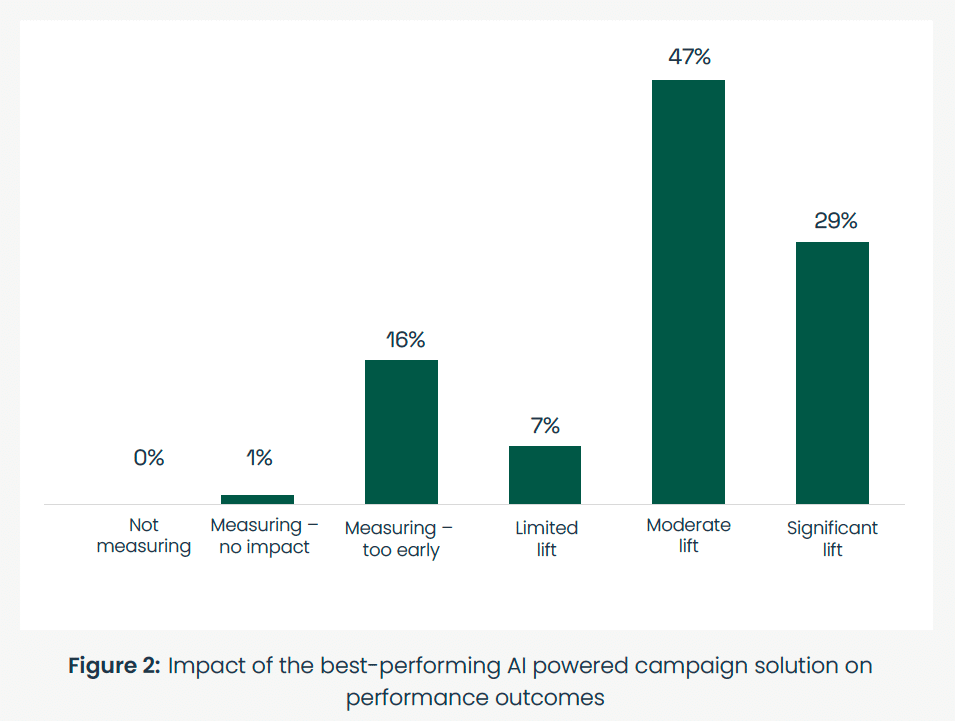
The survey respondents are all people responsible for real performance budgets, and their response was overwhelming: 76% of them are seeing meaningful improvement from their use of AI-powered platforms such as Meta’s Advantage+ and Google’s Performance Max (PMax). To further break down that 76%:
- 47% of respondents see a moderate performance lift.
- 29% of respondents are seeing a significant lift from their AI platform.
For 7% of respondents, they see a limited lift with their AI-powered solution. Just 1% report no impact on performance. For the vast majority of respondents, AI-powered campaign platforms are delivering visible, valuable impact.
Why “Measuring But Too Early” is a Bullish Signal
17% of the decision-makers surveyed say they’re measuring the results of their AI-powered solution, but that it’s still too early to gauge the impact. Crucially, though, these survey respondents are conducting testing on how AI-powered platforms can work for their needs: they’ve committed budget and assigned resources to execute proof-of-concept projects and pilots. Platform adoption patterns suggest that when measurement is complete, it resolves positively for companies committed to performing testing.
Why CPA/ROAS Optimization Is the Core Mechanism Driving Lift
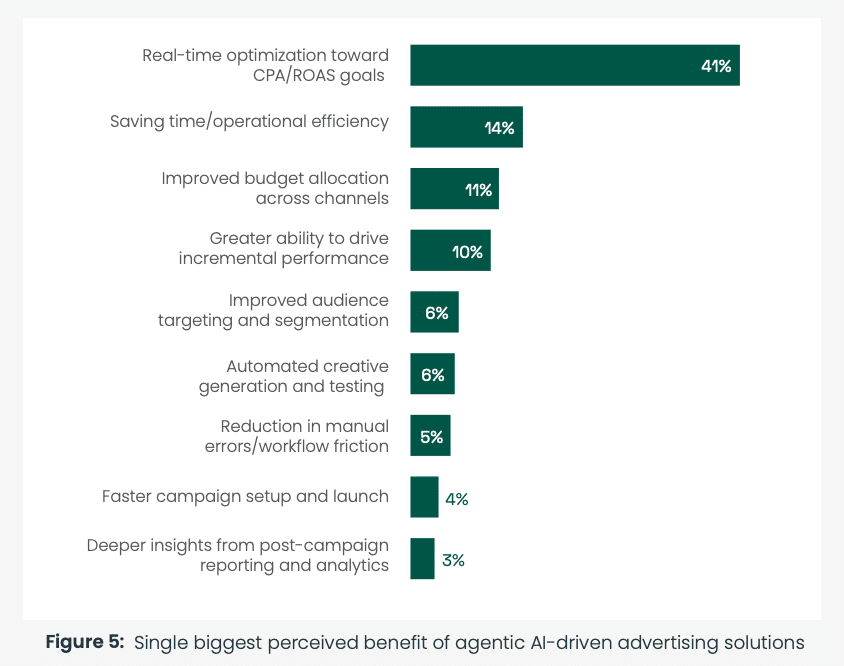
The survey data shows a clear picture of how agentic AI can help marketing and advertising teams. 41% of respondents say the top benefit of AI-powered solutions is the real-time optimization toward cost per acquisition (CPA) and return on ad spend (ROAS) — two of the most important metrics that advertisers use to gauge success and growth. Time savings was the second-ranked benefit for 14% of respondents, while improved budget allocation was top for 11% of respondents.
These numbers show how important agentic AI results are to performance marketing teams, who are held accountable for specific, growth-focused metrics. Real-time ROAS or CPA optimization is far more valuable to these teams than the time savings, reporting, or creative automation, because it’s doing the right work at the right time faster than any human team could execute.
All of the above is why it makes sense that Meta Advantage+ and Google’s PMax have achieved near-total adoption. Those platforms deliver for performance marketers against the metrics that matter most to them. This is also why agentic AI in performance marketing solutions can scale so well, and why it can help new channels grow very quickly.
The Gap Between What Humans Optimize, and What Machines Can
Real-time CPA and ROAS optimization for performance marketing is an ideal use case for agentic AI, because it offers a solution to a problem that humans alone can’t solve. Day-to-day, this type of operational optimization work happens continuously — adjusting bids, reallocating budget, rotating creative work according to its performance, and refining audience targeting.
Human teams can only do this work in pieces, checking a dashboard once or twice a day, with a longer optimization cycle. Real-time, AI-driven performance marketing tools can respond to each signal as it arrives. Thousands of micro-optimizations compound quickly, as they’re completed faster and more consistently than any human team could execute. Over the course of a campaign, that cycle speed difference makes a big impact. The performance lift from agentic AI doesn’t rely on one concerted effort by human teams, but on continuous, back-end technical work.
Making the Financial Case for Diversification Among Diminishing Returns
This kind of performance lift in CPA/ROAS is a primary driver of budget decisions, too. Ad spend efficiency — ROAS — continuously drives performance marketing decisions, with search and social channels typically making up most of the budget. The survey found that 74% of respondents allocate 25% or more of their budget to paid search, and 67% do the same for paid social. These are the most heavily resourced channels in the performance mix and, tellingly, the biggest spenders are hitting the ceiling of these channels most acutely.
When More Spend Stops Meaning More Results
Search and social have served businesses very well, and agentic AI has proved in the survey data to be an effective tool to drive search and social performance. While search and social remain the dominant channels, though, they’re becoming saturated. That saturation shows up for performance marketers as diminishing returns based on the same or increased spending.
Once marketing teams have optimized everything they can in search and social, incremental growth has to come from somewhere else, and that’s the open web, based on the data. A clear 70% of survey respondents spending more than $5 million per month say that it’s “extremely important” to find an incremental performance channel. Three quarters of survey respondents said it’s either very or extremely important to identify a performance channel to deliver incremental performance uplift beyond the walled gardens of search and social.
Budget concentration in search and social reflects the typically strong returns of those channels, but the concern is scale. Returns that were strong with an investment of $500,000 a month does not automatically scale proportionally to $2 million or $5 million a month. Increased audience saturation and high-intent keyword competition mean that the cost of reaching an incremental customer just keeps rising.
Budget Allocation Today vs. Where It’s Going Next
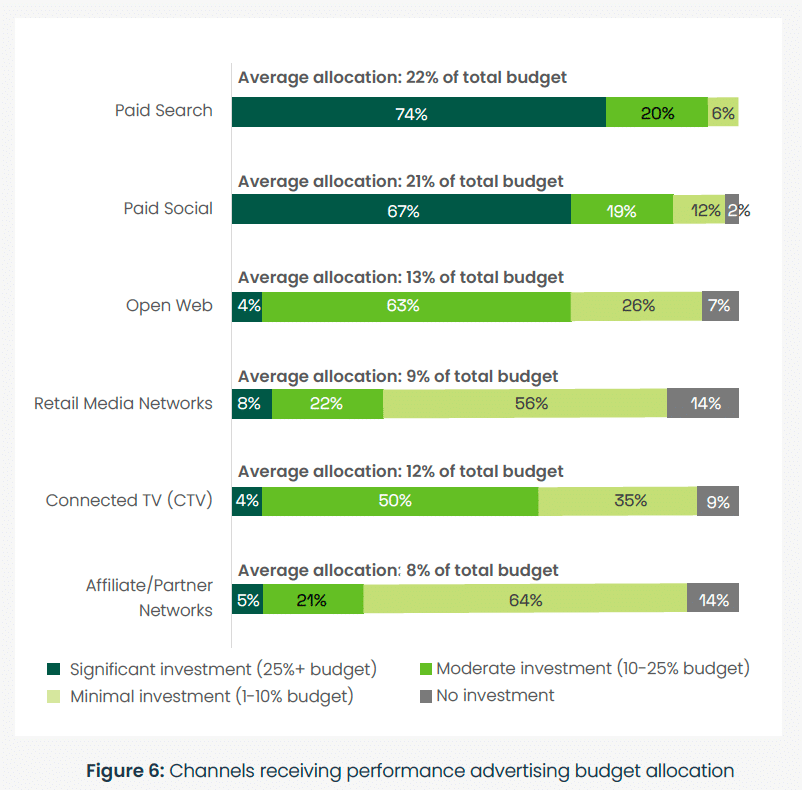
The need for channel diversification is critical in the face of saturated performance advertising channels, and the survey data shows the decision point that many marketing leaders are facing. The current investment looks like this for performance marketing budgets, based on survey responses, with numbers reflecting the allocation of total budget:
- Paid search: 22%.
- Paid social: 21%.
- Open web: 13%.
- Connected TV (CTV): 12%.
- Retail media networks (RMNs): 9%.
- Affiliate: 8%.
For the future of budget allocation, though, almost all of the survey respondents — 99% — say they would allocate budget to the open web if there were agentic AI solutions to use there. The average expected allocation would be about 24%, double what it is today, with the intent to invest even more strongly among the biggest spenders.
That increase in investment in the open web would shift its importance in the channel mix and in the performance budget. With search and social remaining strategic pillars, new budget investment on the open web would be an ideal opening for performance marketers.
What the Budget Intent Data Actually Says
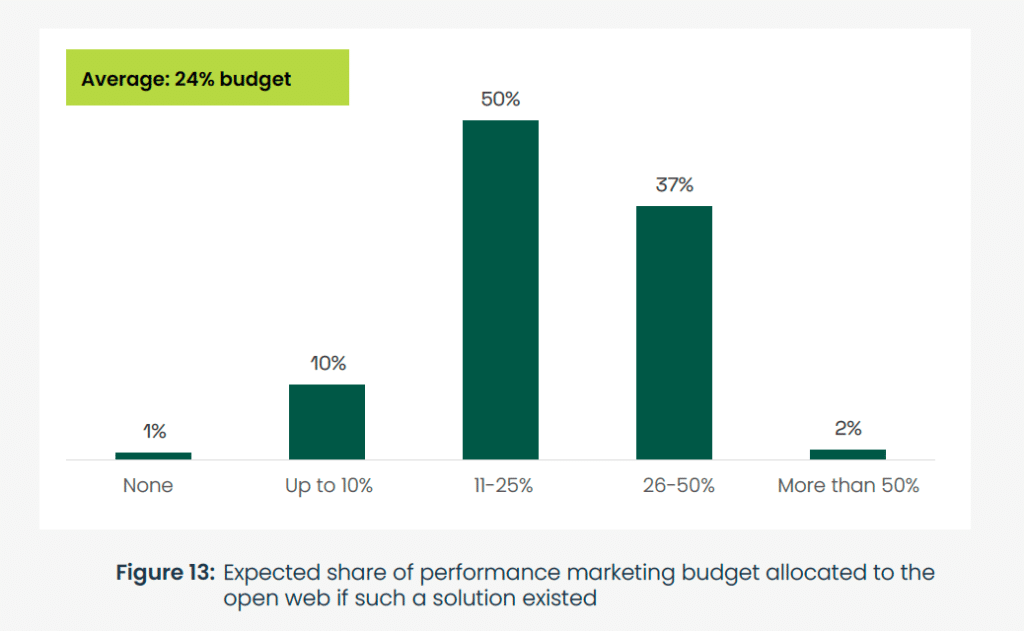
There’s a stark contrast between the 4% of performance marketers investing significantly in the open web, compared to those who would like to invest if agentic AI solutions existed for it — 39%. Those respondents say they would invest 26% or more if agentic AI solutions existed. At this decision point for performance marketers, the gap between those numbers reflects a strong demand signal for a new, confidence-inspiring channel.
What’s missing in this moment is the infrastructure to make open web advertising investment easier. Marketers need the same automated, goal-based buying capabilities they can currently get from PMax and Advantage+, but for the open web.
How Agentic AI Changes the ROI Calculus for the Open Web
It’s clear that there are lots of potential opportunities for the performance marketers and advertisers working toward incremental reach and new audiences outside of search and social. With agentic AI proving its value in popular search and social platforms, the open web is next up to put performance budget to work in new ways. The proof is in the 81% of respondents who say they’d increase open web investment if they had automated, AI-powered campaign solutions to use.
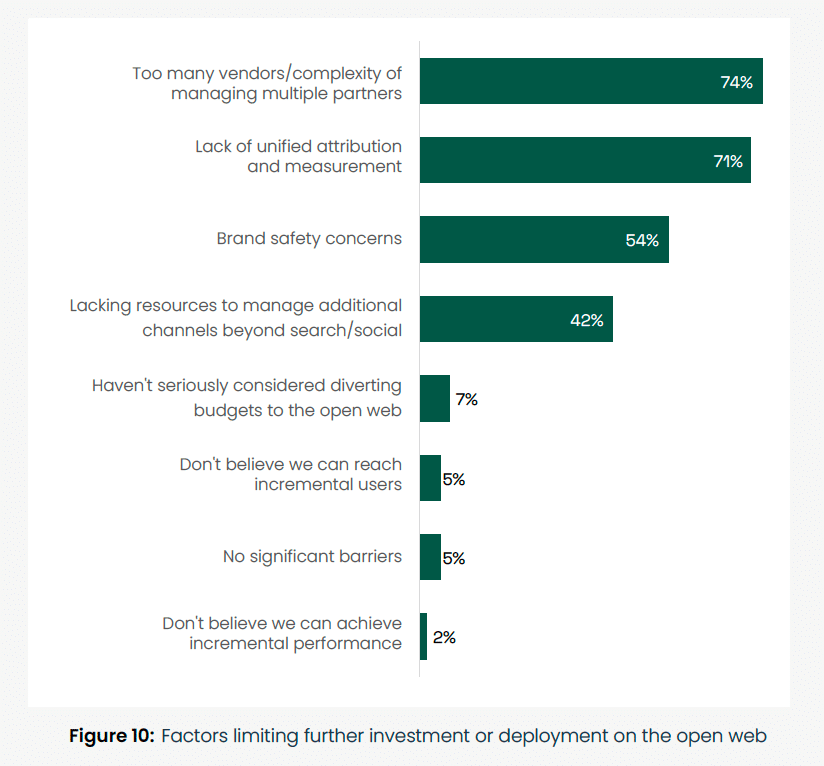
“Automated” is key here — the ROI calculation changes when AI-driven automation is in the picture for performance marketers. Survey respondents mentioned a few barriers to open web investment: too many vendors (74%); lack of unified attribution (71%); brand safety concerns (54%), and resource constraints (42%).
Those concerns are the ones that a well-designed agentic system can reduce, mitigate, or remove entirely. A single interface, unified reporting, automated inventory controls, and autonomous execution, all within a single, AI-powered platform, can address the specific hesitations that lead to underinvestment in the open web.
The Financial Argument Is Settled, So the Real Question Is Execution
The takeaways for curious, data-driven performance marketers and leaders are clear from the survey: first, agentic AI has proved ROI value in two channels (Advantage+ and PMax), based on 76% of survey responses. It’s driven the specific performance results that marketers need — increased CPA and ROAS optimization. That’s a refreshing data point in the face of a lot of uncertainty around how AI can actually drive bottom-line business results.
Second, based on survey responses, there is both strategic urgency and budget intent to expand this agentic AI model to the open web to grow performance marketing results. The missing variable is the infrastructure to convert intent into investment. Performance marketing leaders can rest assured the model exists, so the only question now is whether they have the operational capability to apply it.


