
- The 2026 Sports Advertising Reality Check
- Strategy 1: The Multi-Signal Performance Engine
- Strategy 2: Turning TV Attention into Digital Action
- Strategy 3: High-Efficiency Intent Targeting
- Strategy 4: Creative Compliance and Visual Best Practices
- Strategy 5: Leverage Display and Rich Experiences
- Key Takeaways: The Realize Advantage
- Frequently Asked Questions (FAQs)
When the best soccer teams meet on the pitch for the World Cup tournament every four years, a global audience of 5 to 6 billion people will be glued to their radios and screens, or lucky enough to attend one of the games over the 39-day stretch.
Pelé, Messi, Ronaldo, Maradona… The tournament becomes a pressure cooker for even the all-time legends. Digital marketers face this pressure cooker, too, though. Adapting your creative advertising strategy for the very specific timeline of the tournament requires a shift from broadcasting to maneuvering. Your creative can’t just sit in a corner; it must respond to the game’s flow.
When attention is the most expensive currency, make sure your brand doesn’t merely contribute to the noise and, instead, help it own the moment.
The 2026 Sports Advertising Reality Check
As we approach this year’s most anticipated sports event, the landscape for digital advertisers has shifted permanently. The good old days of buying broad sports demographics has gone, like a 30-yard screamer. Teams need a sweeper-keeper to succeed in this more challenging reality.
A Sea of Sameness
One word best describes the sports and entertainment market: oversaturated. From official sponsors to ambush marketers, every brand is jockeying for position in front of the same eyeballs. This saturation makes it harder than ever to stand out or drive incremental impact. You’re up against viral highlights, memes, and real-time match drama.
The Walled Garden Trap
Access to premium sports audiences often lives within walled gardens — social media giants or closed ecosystems that limit your scale and provide little transparency into where your spend goes. You’re playing on their turf, by their rules, and with their data.
The Solution
Winning in 2026 requires surgical precision. Driving solid performance means reaching fans across the open web, on the sports news sites, match blogs, and publisher homepages where they spend time researching and debating. Enter Realize, a franchise player and open-web performance marketing platform with one of the largest footprints in sports supply and audiences.
Strategy 1: The Multi-Signal Performance Engine
Just as the best players scan the field before receiving or passing the ball, your creative must orient itself to the fan’s immediate environment.
Direct Publisher Integrations
Don’t compete for the loudest space. Find the pockets — those micro-moments between matches or during halftime where attention is high, but the general noise is lower. Realize provides direct paths to these pockets through 11,000+ embedded publisher integrations, placing your brand in front of fans when they’re most likely to lean in.
Performance-Tuned AI
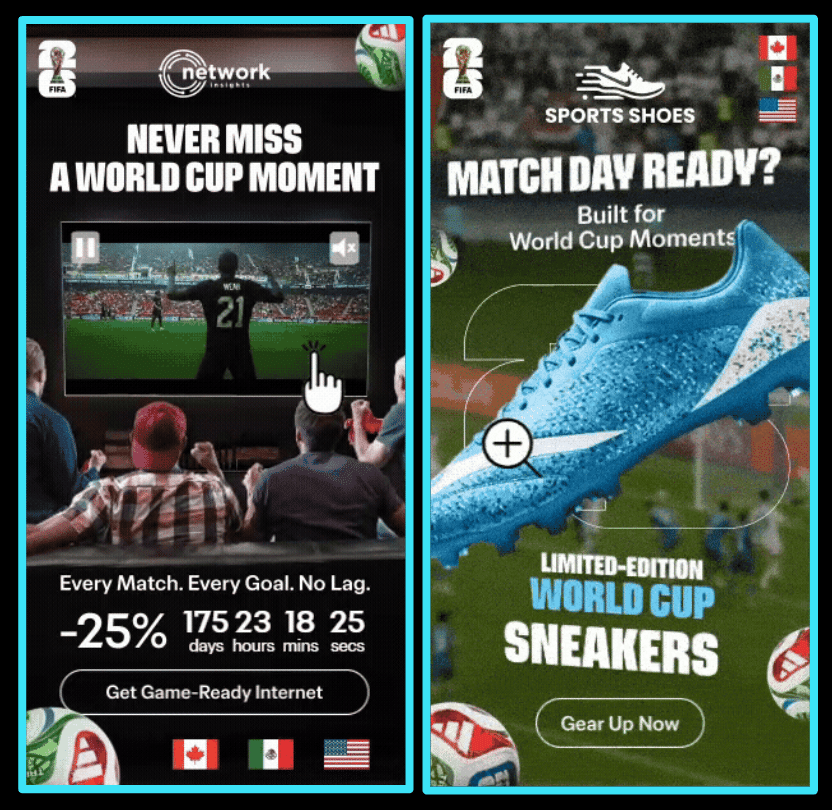
Use specialized artificial intelligence (AI) optimized for outcomes and mid-to-lower funnel performance, like purchase and consideration. Automated tools can swap creative elements like flags, scores, or player archetypes in real time. Ads that acknowledge a live score or recent upset consistently outperform generic “Go, Team!” creative on return on ad spend. Dynamic creative that updates with the match — reflecting scores, momentum shifts, or local context — keeps content connected to what fans are actually experiencing.
Behavioral Visibility
Canada, Mexico, and the United States will host the 2026 tournament. Tailor your visuals to specific host cities (Toronto, Mexico City, and Philadelphia) or national heritages. If you target fans in Miami, use hometown visuals to create an immediate psychological bond that generic global ads can’t match. Leverage proprietary data signals that provide visibility on user behavior across paid and organic content.
Strategy 2: Turning TV Attention into Digital Action
In soccer, La Pausa is the art of the intentional delay. A playmaker pauses on the ball, drawing the defense out of position before delivering a lethal pass. For digital marketers, this strategy is your La Pausa moment: you wait for the broadcast signal to pull in your audience, then execute a precise digital strike on the second screen.
Bridge the Gap
The tournament is an enormous TV event, but the clinical finish happens on a fan’s mobile device. The living room wall shouldn’t silence your strategy, and you can extend your sports reach beyond the broadcast by using trusted audience providers. When the match pauses or halftime hits, seize that moment to release the pass and engage fans transitioning from the big screen to their phones.
Target Viewership Signals
Mastering this timing requires the right data signals. Realize leverages third-party signals from providers like Nielsen TV Network to reach fans based on their actual cable and media consumption. If a fan is watching the match on their TV, our platform identifies that signal and serves a perfectly timed digital ad to their mobile device. This precision timing reaches fans with equal accuracy as their match-day adrenaline peaks.
Interest-Based Targeting
Just as a midfielder anticipates a striker’s run, you can anticipate a fan’s next move. By layering interest-based targeting, you connect with fans actively searching for:
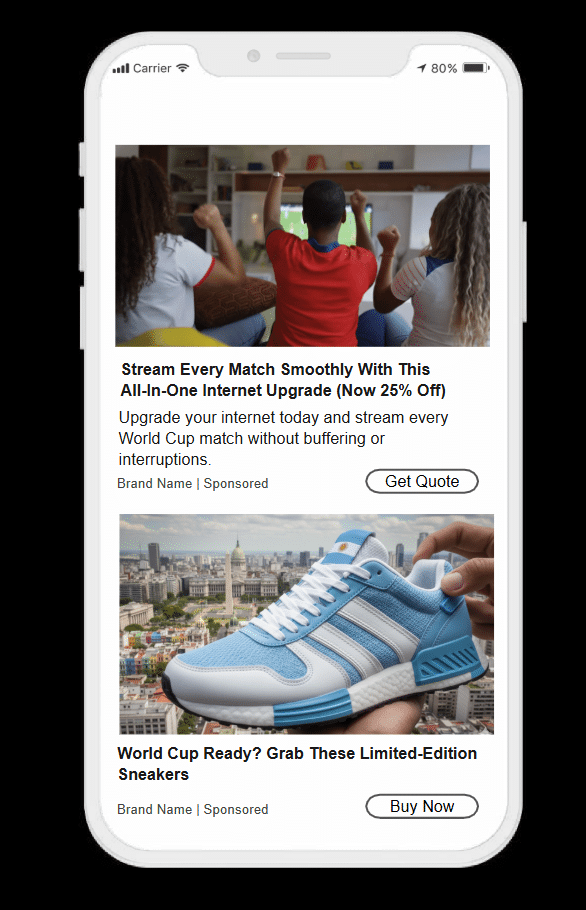
- Sportswear and sporting goods (the gear up intent).
- Sports cars and luxury goods (the aspirational fan).
- International travel (the host city visitor).
When you combine TV viewership data with high-intent search signals, you can deliver a personalized message to someone already moving toward a purchase. This synchronization turns passive viewing into measurable digital action.
Strategy 3: High-Efficiency Intent Targeting
Elite scorers don’t waste movement. They don’t indulge in flashy dribbles that lead nowhere because they’re focused on the most efficient path to the goal. In terms of marketing, this strategy takes you beyond broad brand awareness to using high-intent data that ensures you design your performance creative for a one-touch conversion.
When the game’s on the line, these intent-driven tactics become your star strikers, delivering the kind of efficiency standard display campaigns can’t match.
Search Keyword Targeting (the Tactical Strike)
Just as a striker anticipates exactly where a ball will land, search keyword targeting allows you to meet fans at the moment of peak interest. By creating segments of fans actively searching for teams, gear, and event-related keywords, you effectively intercept users at their highest level of intent.
The result: A surgical approach to reduce cost per acquisition (CPA). You haven’t guessed who’s interested — you’ve responded to a signal they’ve already sent.
Mail Domain Targeting (the Competitive Pocket)
Great players find the pockets — those sections of the pitch others overlook. Mail domain targeting allows you to reach high-intent audiences based on their inbox behavior. You can target people subscribed to sports newsletters, competitor fan sites, and team communities. This strategy facilitates competitive conquesting, where your brand appears in front of fans who are already deeply engaged with the niche.
The result: This tactic reduces CPA because you’re reaching users who are already in a tactical, to-do list mindset, so they’re more likely to click through and convert.
Predictive Audiences (Identifying the Next Play)
A world-class playmaker operates like a chess master, seeing where the players are now and anticipating where they’ll go next. Realize’s Predictive Audiences feature uses AI to identify tomorrow’s buying behavior today. The platform analyzes proprietary signals to identify incremental audiences exhibiting the same behavioral patterns as your current top converters.
The result: This forward-looking strategy lifts conversion rates (CVR) and lowers CPA, allowing you to expand your reach into untapped territory without the “spray and pray” waste of traditional prospecting.
Strategy 4: Creative Compliance and Visual Best Practices
In a global tournament of this scale, to win the game, you have to play within the lines. Intellectual property (IP) enforcement for major soccer events is notoriously aggressive, and one foul can red-card your entire campaign.
Strict Usage Guidelines (Avoiding the Red Card)
The most important rule in your creative playbook is to avoid protected trademarks. Don’t mention official event names (like “World Cup”) or use iconic logos like the FIFA trophy within your ad assets or digital decks. Using these strictly guarded assets without an official sponsorship can lead to instant campaign takedowns or legal repercussions.
Visual Workarounds
Capture the spirit. Even if you can’t use the official logo, you can still capture the event’s energy. Incorporate visual workarounds that signal soccer to a fan’s brain (but don’t trigger a legal flag). For example:
- Focus on the movement: players in action, such as silhouettes of a striker or a goalkeeper mid-dive.
- Use textures of the game: high-contrast shots of lush grass, a goal net’s geometric pattern, a stadium’s lighting flare.
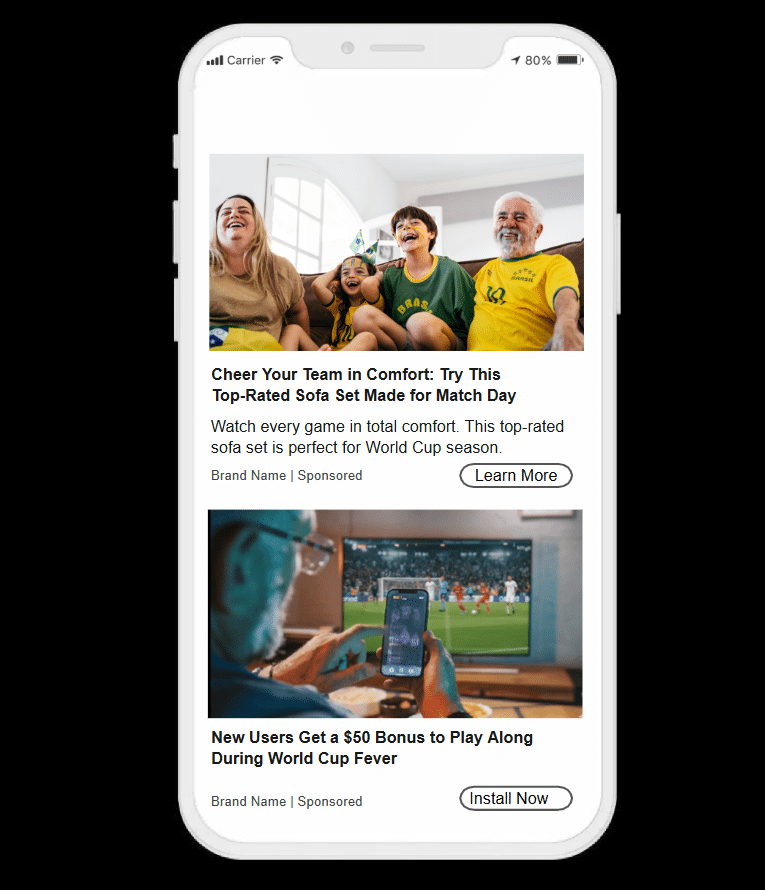
- Showcase watch-party chaos: faces painted in team colors, the crowd’s shared emotion, flag-waving fans.
Verbal Flexibility (the Sideline Conversation)
While your written assets and digital creative must comply completely, you’ve got a little verbal wiggle room. Sellers and account managers can reference official event names during live, informal, and non-recorded presentations. This flexibility allows you to align behind the scenes on strategy and goals while keeping your public-facing creative within the rules of the pitch.
Strategy 5: Leverage Display and Rich Experiences
Stick with static banners if you want to play it safe. If you want to break through the defense in a tournament defined by movement, flair, and intensity, don’t leave your rich media on the bench.
Capture High Fan Energy
Soccer audiences engage the most on match days. Use display formats to amplify that momentum, catching fans while they’re most likely to react.
Stand Out in a Crowded Season
With thousands of brands shouting at once, use rich visuals — like motion ads or immersive carousels — to cut through the high-volume competition surrounding tournament content.
Localize Team Pride
Adapt your display assets using team colors, specific rivalries, or host-city themes (e.g., Vancouver, Philadelphia, Mexico City). Local relevance is a serious driver of second-screen attention.
Drive Mid-Funnel Impact
As fans browse match news and player updates, use premium formats to reinforce consideration and keep your brand top-of-mind during game pauses.
Key Takeaways: The Realize Advantage
When the final whistle blows, you’ll measure your campaign’s success by its efficiency and outcomes. Working with Realize means your budget works as hard as a defensive midfielder who covers every inch of the pitch.
Price Per Performance (eCPC)
With enhanced cost-per-click, (eCPC), you only pay for meaningful engagement. If the fan doesn’t lean in, you don’t pay.
No Ad Tech Tax
We’ve removed the friction. All of your budget goes toward working media — no fees for platform usage, data, or brand safety tools.
Brand Safety
Realize uses advanced third-party verification from DoubleVerify and Integral Ad Science (IAS) to ensure your ads appear only in relevant, safe, and brand-aligned environments.
Frequently Asked Questions (FAQs)
How can my brand compete for attention during a major global tournament without an official sponsorship?
Most brands navigate this challenge by using ambush marketing or moment-driven content. Since you can’t use protected trademarks, your campaign’s success depends on lean, reactive creative focused on universal soccer themes (think: grass, stadium lights, crowd emotion). Marketers often lean into national and team colors and fan rituals to form an immediate psychological association with the event. This strategy relies on high-volume creative testing and real-time social engagement to cut through the noise of official sponsors.
While the industry plays the volume game, Realize offers a more precise alternative. By accessing 11,000+ publishers directly, you can bypass the crowded walled gardens where everyone is fighting for the same social feed. Realize empowers you to reach fans in brand-safe editorial environments as they consume match analyses and news. By using proprietary signals (like targeting fans searching for player rankings or viral highlights), you ensure your creative hits the right enthusiast at the moment their interest peaks.
With so many fans using second screens, how do I ensure my digital ads actually drive sales instead of just impressions?
Since about 80% of fans use mobile devices while watching sports, the industry has adjusted its approach. It moves fans from passive viewing to owned apps or sites using interactive content. Common tactics include using augmented reality (AR) filters, real-time polls, or limited-time match-day offers to create urgency. The goal? Shifting key performance indicators (KPIs) from vanity metrics like reach to behavioral outcomes (app downloads, newsletter sign-ups), which teams can nurture into sales later.
Realize is built exclusively for performance, with 100% of its AI tuned to mid- to lower-funnel outcomes, not just awareness. We specifically target second-screen behavior by bridging the gap between TV and digital. By using viewership signals from providers like Nielsen TV Network, Realize re-engages fans on their mobile devices as match-day excitement peaks. This strategy converts passive attention into measurable actions, like “Gear Up Now” conversions or direct ticket sales, while the fan is already in a tactical mindset.
How do I manage the high cost of advertising during peak tournament periods?
Competition during global finals often drives costs per mille (CPMs) to extreme levels in limited-inventory environments like social media. Seasoned marketers try to get a head start, launching lead-gen campaigns a month before the tournament begins to build a retargeting pool. Others use programmatic private marketplace (PMP) deals to lock in rates and avoid the most extreme price hikes of the open auction during the knockout rounds.
Realize effectively eliminates the ad tech tax by removing platform fees for data and brand-safety tools. Your whole budget goes toward working media. The platform also operates on a price-per-performance (eCPC) model, where you only pay for meaningful engagement. Predictive Audiences — which identifies tomorrow’s buyers before they become too expensive to target — bolsters this efficiency. Our partners historically see a 15% lower CPA — even during the tournament’s most competitive windows — by finding these incremental audiences early.


