
- Trend 1: The Primacy of Mobile-First Experiences and Optimization
- Trend 2: Leveraging AI and Personalization in Mobile Marketing
- Trend 3: The Continued Dominance of Video and Immersive Content on Mobile
- Trend 4: The Rise of Mobile Commerce and Seamless Payment Options
- Trend 5: Navigating Privacy Changes and Building Trust in Mobile Marketing
- Key Takeaways
- Frequently Asked Questions (FAQs)
- What are the most effective mobile advertising formats in 2026?
- How can brands measure the ROI of their mobile marketing efforts?
- What are some common mistakes to avoid in mobile marketing?
- How is 5G technology impacting mobile marketing opportunities?
- What are the key performance indicators (KPIs) for successful mobile marketing?
Mobile is the primary channel through which customers experience your brand, often long before they see it anywhere else. Strong mobile campaigns start with understanding how people scroll, search, and buy on their phones, rather than treating mobile as simply a smaller version of desktop. Here are five trends shaping mobile attention in 2026, and what they mean for your marketing strategy.
Trend 1: The Primacy of Mobile-First Experiences and Optimization
Mobile shoppers abandon sites quickly when design and performance hinder their experience. Slow load times, crowded layouts, or tiny tap targets give people a reason to leave and choose a smoother site. That’s why a mobile-first approach starts with design and performance. Teams should plan layouts, navigation, and forms for small screens first, then adapt them for desktop. Menus stay simple, tap targets stay large, calls to action stay clear, and pages load quickly with lean code and compressed assets.
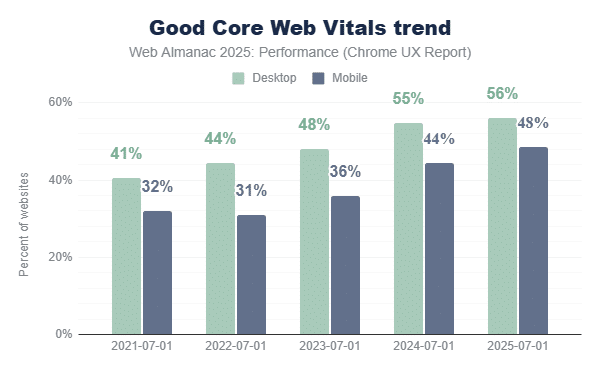
Source: Web Almanac
Mobile SEO has become baseline SEO: If your pages are not fast, responsive, and easy to crawl on mobile, it will affect how you show up in rankings, as well as in how often your content appears in features such as carousels and rich results. Voice searches and on-the-go queries only raise the bar further.
Stats on mobile usage and performance:
- In 2025, consumers spent roughly 5.3 trillion hours in apps on iOS and Google Play, up nearly 4% year over year.
- The average smartphone user spends over 3.6 hours per day in apps, across 34 apps per month.
- 62% of mobile pages achieved a “good” Largest Contentful Paint score in 2025, compared with 74% of desktop pages.
Trend 2: Leveraging AI and Personalization in Mobile Marketing
Marketing teams lean on artificial intelligence (AI) to plan, create, and adjust campaigns. In mobile channels, it supports ad targeting, recommendations, in-app experiences, and chat-based support.
AI also helps tailor mobile experiences in real time. Brands can adjust creative by audience, device, and context, surface products based on recent browsing, and time push notifications to when people are most likely to respond. Predictive analytics can flag churn risk, suggest next-best offers, and guide retention efforts. Dynamic creative optimization can automatically swap in the strongest assets, while responsibly-used location signals help tailor offers to where people actually are.
Marketers are relying more than ever on platforms that can test multiple creative variations simultaneously, import social assets into open web campaigns, and let algorithms push spend toward what performs well on mobile. People notice when targeting feels intrusive, or when data use is hard to understand: Overly aggressive tactics and unclear data practices erode trust, so teams that use AI to make experiences more useful, and explain in plain language how they use data, tend to see better long-term results.
Key stats about AI and personalization:
- In a 2026 marketing survey, about 94% of marketers said they plan to use AI in content creation.
- The same survey shows that 45% of marketers use smart image-editing tools, 44% use video or animation generation tools, 42% use smart video or audio editing, and 40% use image or design editors.
- The study also makes it clear that nearly 75% of marketers already use AI to create media such as images and videos.
Trend 3: The Continued Dominance of Video and Immersive Content on Mobile
Short-form video has become the main format people watch on their phones. Vertical clips match how people actually use their devices, with quick sessions, optional sound, and heavy scrolling. Augmented reality (AR) and other immersive tools sit alongside that feed and give people ways to try products, rather than just watch them.
Shoppers’ mobile journeys often start with short-form social video, before moving into deeper research and comparison. TikTok, Reels, and Shorts all reward content that hooks in the first seconds, uses captions, and feels native to the feed. Brands need focused messages, strong visuals, and landing experiences that match the clip.
Retailers can use AR and interactive formats to help people picture products in their own space. Virtual try-ons, room visualizers, and shoppable videos help people to understand and test products without leaving the app. Interactive and gamified units, such as quizzes or playable videos, extend that behavior and keep people engaged longer than static placements. User-generated video and creator partnerships often carry more weight than polished brand spots and can be reused across ads, landing pages, and in-app modules.
Mobile video and AR by the numbers:
- In Q3 of 2025, Snapchat had 477 million daily active users and 943 million monthly active users.
- Per the same source, more than 350 million people used Snapchat’s augmented reality experiences daily during the third quarter of 2025.
- In the same period, users played with AR Lenses approximately 8 billion times per day.
Trend 4: The Rise of Mobile Commerce and Seamless Payment Options
Shoppers often discover products, compare options, and check out without ever leaving their phones. When the path feels simple and trustworthy, they complete the purchase on that same screen.
Shoppers expect digital wallets and alternative payment options in mobile checkout flows. Apple Pay, Google Pay, PayPal, and local wallets reduce friction by removing manual card entry. BNPL, subscriptions, and saved payment details streamline repeat purchases. Retailers use owned mobile apps to store credentials, run loyalty programs, save preferences, and send push notifications that bring people back to shop again.
Social commerce and in-app stores pull even more shopping activity onto phones. Shoppable posts, live shopping, and native storefronts on platforms like Instagram, TikTok, and YouTube allow users to move from inspiration to purchase without leaving the environment. To maintain high conversion rates, brands need clean mobile carts, guest checkout, clear shipping and fee breakdowns, and consistent experiences across mobile web and apps.
Key mobile commerce stats:
- From November 1 to December 31, 2025, U.S. online shoppers spent $257.8 billion, up 6.8% from the 2024 holiday season.
- During the 2025 holiday period, smartphones accounted for 56.4% of U.S. online transactions.
- On Christmas Day 2025, smartphones accounted for 66.5% of online transactions, and on Thanksgiving Day, 61.6%.
Trend 5: Navigating Privacy Changes and Building Trust in Mobile Marketing
Marketing plans must account for what data is collected, how long it is retained, and who can access it. Tracking limits, new privacy laws, and rising user expectations are reshaping how mobile data is collected and used.
Regulation is tightening as well. As of late 2025, roughly 20 U.S. states have comprehensive privacy laws in place or on the way, with several more expected to take effect in 2026 and beyond. New rules spell out which companies are covered, how teams must manage consent, and what rights consumers have over their data.
Teams rely more on first-party data, clear consent, and privacy-respecting approaches. They use clearer language in consent flows, offer more granular controls, rely more on contextual and cohort-based targeting, and rely less on one-to-one tracking and more on modeled conversions and incrementality tests. Performance partners can rely on predictive, intent-based audiences and modeled conversions, rather than identity-based tracking, to maintain measurement as privacy tightens. Teams that explain what they collect, why they collect it, and how it improves the experience make it easier for people to say yes.
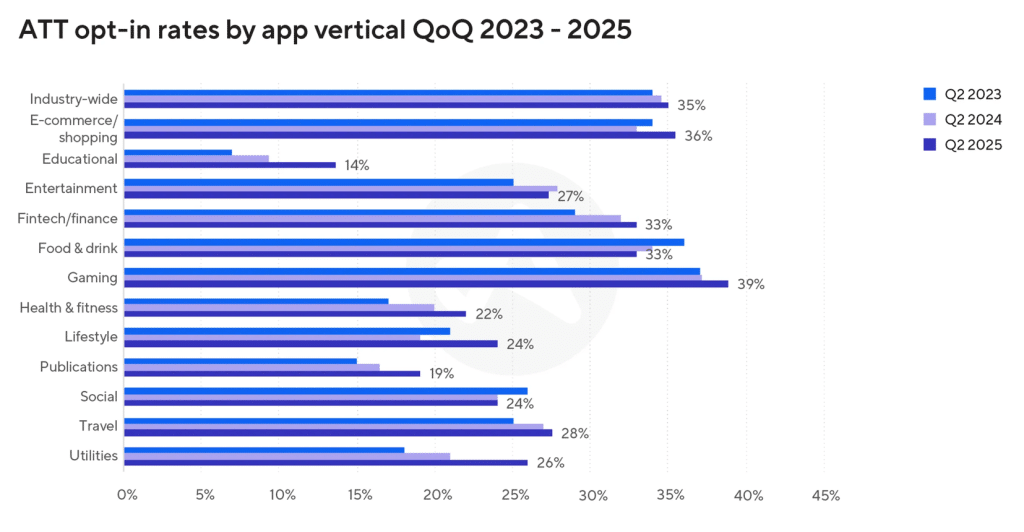
Source: Adjust
Privacy and consent stats to know:
- By Q2 2025, the average app tracking transparency opt-in rate reached 35%, up from 34.5% in Q2 2024 and 34% in Q2 2023.
- In 2025, gaming apps saw higher consent rates, per the same source, with opt-in rates of 50% for sports titles, 43% for hyper-casual games, and 40% for action games.
Key Takeaways
Mobile is the primary channel for discovering and buying from brands, so mobile UX and performance come first. AI and personalization support most mobile programs when teams use them transparently to improve relevance. Short-form video and immersive formats, such as AR, capture most of the attention on phones and belong in the core content plan. Phones have become a primary checkout channel, so clean carts, clear pricing, and flexible payment options directly drive revenue. Tighter privacy rules and higher user expectations make clear consent, first-party data, and privacy-safe measurement basic requirements for mobile marketing.
Frequently Asked Questions (FAQs)
What are the most effective mobile advertising formats in 2026?
In-feed native ads, vertical short-form video, shoppable placements, and app campaigns tend to work best on mobile. Keep them fast, platform-native, and focused on simple mobile landing pages, using rewarded or playable formats only when the value exchange is clear.
How can brands measure the ROI of their mobile marketing efforts?
Tie metrics to clear goals. For acquisition, track installs, signups, or leads. For revenue, track mobile conversion rate, average order value, and revenue by device. Use incrementality tests or lift studies to see what mobile actually adds.
What are some common mistakes to avoid in mobile marketing?
Common issues include shrinking desktop layouts onto phones, overusing pop-ups, sending generic push notifications, and driving traffic to slow or cluttered landing pages. Ignoring consent preferences or hiding privacy controls also hurts trust and long-term performance.
How is 5G technology impacting mobile marketing opportunities?
5G improves speed and latency where coverage is strong, which helps with high-quality streaming, live video, and responsive AR or interactive content. It enables richer experiences, but does not eliminate the need for performance-friendly pages and apps.
What are the key performance indicators (KPIs) for successful mobile marketing?
Useful KPIs include mobile traffic share, app installs, active users, in-app or on-site time, and engagement metrics such as taps and video completions. On the performance side, track conversion rate by device, cost per acquisition, revenue per user, and retention or churn. Over time, connect these to customer lifetime value to assess whether mobile efforts are attracting the right customers.


