
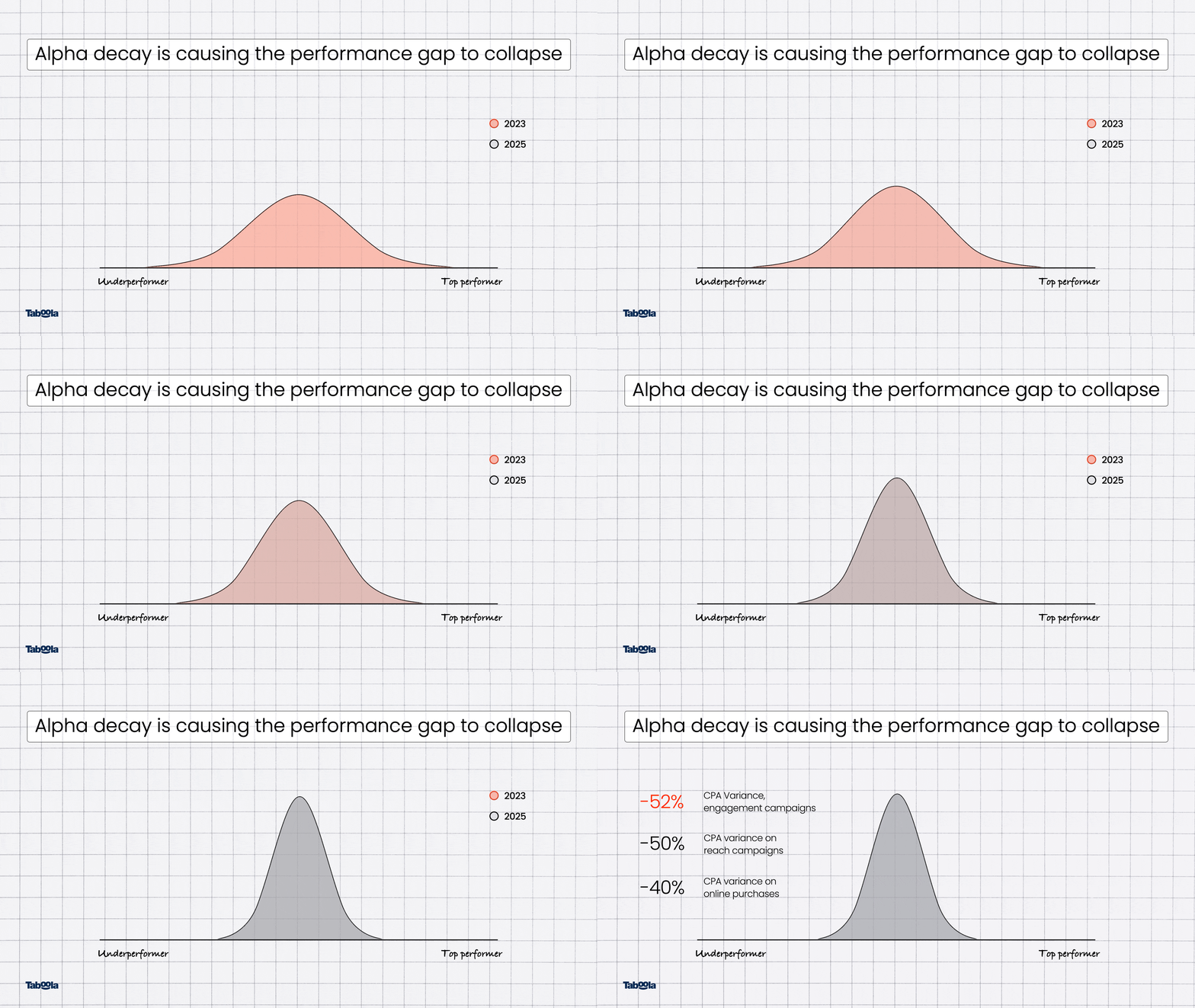
For senior marketers and growth leaders, AI has been an incredible tool for scale. The only problem: it’s been an incredible tool for every other marketing and growth team to scale, too. Data shows that cost per action (CPA) variance shrank by about 50% between 2023 and 2025 on Taboola’s network, according to Tom Inbal, SVP of strategic and corporate marketing at Taboola, who spoke at the OMR Festival recently.
His observation points to the uncomfortable truth that the more everyone adopts AI, the harder it becomes to stand out. Realize data also found that 98% of marketers are actively using or testing agentic AI to run parts of their workflow.
So, while AI is the best tool you can use to grow your performance campaign success, it’s likely also the reason you feel like performance is plateauing. Your particular AI stack on its own won’t make you stand out, because everybody is using the same tools.
In this article, I’ll explore the concept of alpha decay, why it’s accelerating for performance advertisers, and what the outperformers are doing differently.
What Is Alpha Decay and Why Does It Matter to Marketers?
In this context, alpha decay is a term taken from quantitative finance. It refers to the measurable gap between your performance and the market average — essentially, how good you are as compared to the average. When thinking of that CPA variance, for example, if your advertising platform’s average CPA is $25 and yours is $18, that gap is your alpha.
This concept has come into play as more advertisers use the same AI tools to optimize toward the same signals, which shrinks the gap between the top and average performers.
“If you’re thinking that your AI stack is your edge, you’re probably wrong,” Inbal said during the keynote. “It’s not really going to make you stand out. Everybody has the tools. Everybody has access to the same answers.”
Why Alpha Decay Applies to Advertisers Now
In quantitative finance, algorithmic trading eroded the edge of early quantitative funds. The alpha strategy is one that can outperform the market by taking calculated risks. Today, as AI democratizes bidding, targeting, and creative optimization, the same dynamic plays out. Alpha decay takes place when performance marketing teams lose their edge, because their competitors have all gained that exact same edge.
What the Data Shows Is Actually Happening on the Open Web
The Taboola data Inbal cites shows how alpha decay is entering the performance marketing arena. Engagement campaigns show a 52% variance reduction, while reach campaigns show a 50% variance reduction. For purchase objective campaigns, it’s a 40% variance reduction.
“AI makes being decent much easier,” Inbal said. “You can do the average easier, but it works both ways. It is that much harder to be an overperformer.”
On top of this, 76% of marketers report meaningful performance improvements from using agentic AI solutions. Looking at the data points in combination, it reflects the trend of AI raising the floor while compressing the ceiling. AI makes poor performance less likely, and exceptional performance harder to achieve at the same time.
Why Standard AI Optimization Accelerates the Problem
Alpha decay is a structural challenge. Information asymmetry, which is what gives most marketing teams their edge, has already been eroded by shared AI infrastructure. As per Inbal’s example in his speech, if every chef at the fish market has a sophisticated AI scanning tool to scan all available fish and recipes, the price discovery becomes close to perfect. The opportunity for sellers to differentiate on pricing or other advantages disappears.
Optimizing harder within the same system isn’t a way to escape the alpha decay issue.
“Alpha decay is happening in our market,” Inbal said. “It means that the average is the trap. It means that if you’re not breaking free of the average, your CFO is thinking this team is replaceable. So, how do you break free of that trap of the average?”
When Everyone Runs the Same Playbook
This may sound familiar to many performance marketers working in advertising firms: your competitors are running similar creatives and using similar targeting logic, and seeing similar CPAs. If 98% of marketers are actively using or testing agentic AI, the tools stop being a differentiator. Near-universal adoption of the technology means it simply becomes table stakes.
You’ve likely been asked whether and how you’re using AI by your leadership team, but the new question now becomes: “What are you doing that AI cannot replicate?”
Why the Instinct to Do More Analysis Makes Things Worse
Performance marketers are data-driven. When uncertainty starts ramping up, it’s common for marketing teams to gather more data and perform even more testing before taking action. It’s a rational response, but it will backfire. If every team runs the same analysis with the same AI tools, they’ll come to the same conclusions and bid on the same opportunities.
When a team does finally determine what action to take, the window has often closed, so what’s the new way to tackle performance marketing goals when all your competitors are doing the same thing? It isn’t doing more and more analysis — it’s creating a better system for taking action despite uncertain conditions. As Inbal puts it, “As marketers, if we don’t exercise the option to be braver, we will be replaced.”
What the Outperformers Are Doing Differently
From Inbal’s work with top-performing advertisers across insurance, health, home and garden, and credit cards, there’s a common thread that drives their success: operationalized courage. Beyond building a culture of risk tolerance, these high performers have built a system for being bold. They’ve developed ways to find new value.
“Being courageous without a system is recklessness,” said Inbal. “Being courageous with a system is how you outperform… For me and my team, we had to come to grips with the fact that we couldn’t analyze our way out of uncertainty.”
This operationalized courage, or systematized risk-taking, is a repeatable process for finding and backing high-potential opportunities. It isn’t the recklessness of throwing money at random ideas, or the excessive diligence of extra testing or data-gathering that delays decisions and actions. “AI is going to favor the bold,” said Inbal, “and the question is: Are you going to be one of the bold and one of the brave or not?”
Developing a Portfolio Mindset of Exploit and Explore
These bold outperformers often approach their marketing and advertising work with the Exploit vs. Explore framework. It’s a structural backbone that allots space for both of these activities. Exploit includes the proven, high-confidence activities that fund exploration without putting the business at risk. Explore includes the deliberate allocation of budget to unproven channels, formats, and strategies, with the expectation that some will fail.
This isn’t a random or loose mix of activities, or just a spending plan, but rather a different way of thinking about testing and learning. If you take a portfolio mindset with Exploit and Explore, you would anticipate losses in the Explore column.
“If you’re expecting everything you do to have a positive return, that’s not a portfolio,” said Inbal. “In a portfolio, you have a mix that exposes you to different risks and opportunities. You expect only some of it to work out.”
The Top Three Patterns the Best Advertisers Use
Outperformers also have some common behaviors that show up in Taboola’s platform data, per Inbal. These are a few operational patterns seen among top performers in advertising:
- Determining a simplified master metric: Choosing a single metric lets teams cycle through testing quickly, without getting lost in conflicting key performance indicators (KPIs), and keeps teams unified.
- Setting a firm testing target: Pick a firm target each quarter for testing new channels, platforms, or strategies, and set accountability for hitting it.
- Incorporating a bias toward momentum: Teams put weight behind early signals quickly, rather than waiting for statistical confidence.
Choosing to take action, prioritizing boldness in a structured way, and using data plus instincts can all help performance teams find new and different success.
“Make your move. AI will give you a lot of clarity that you never had before, but it won’t make the move,” Inbal said. “AI does not have style. It does not have a sense of belonging or accountability. It does not have a team that it trusts. So, you can make that move because you saw some promising early data, and because there’s someone on your team who is passionate and you believe in their instincts. These are valid reasons to dare and to explore.”
How Realize Helps You Escape the Alpha Decay Trap
Realize and Realize+ each play a role in the Exploit vs. Explore framework. Realize+ serves as the autopilot for the Exploit function. It can handle proven, high-confidence campaigns autonomously to protect efficiency and free the team’s time and budget. Realize serves as the copilot for the Explore function, where alpha is still available. It lowers the cost per creative test, making it possible to run more experiments without proportionally increasing production overhead. Together, they create the practical infrastructure that makes a portfolio strategy possible.
“If it’s very tried-and-tested for you, it’s probably tried-and-tested for others,” said Inbal. “So, the trick is to use Exploit to give you the confidence that you can afford to explore. AI lets you do a lot more exploration.”
Key Takeaways
If you’re doing everything right with performance marketing optimization, and still see any advantage slipping away, you’re not alone. You can trust your instincts — and the data to back them up. At this stage in an alpha decay construct, seize the opportunity to do something different. Most teams will respond by optimizing harder within the same system, but marketers who build a parallel exploration system will be much more rare, and more valuable. Now is the time to choose to be bold.
Frequently Asked Questions (FAQs)
If AI is causing alpha decay, why should I invest more in AI tools like Realize?
There’s a difference between using an AI as a commodity, where everyone does the same thing and loses any advantage they had, and using AI strategically to open up capacity for exploration and gain new advantages. AI doesn’t universally cause alpha decay. It erodes alpha when it’s used for exploitation, but if AI is used to automate the baseline and lower the cost of creative testing, it can become the engine of exploration, instead of dragging down performance. Advanced AI tools can help increase speed and identify opportunities to capture returns before your competitors do.
How do I know if my marketing is suffering from alpha decay right now?
When marketing is suffering from alpha decay, your competitive edge — like messaging, channel, or targeting — has become commoditized or stale. To tell if your marketing is suffering from alpha decay, there are three observable signals to track. First, you can see CPA variance compressing quarter over quarter. Next, creative testing velocity has slowed while time required for analysis has increased. And third, the team is spending more time optimizing existing campaigns than launching new ones. As a starting diagnostic, benchmark your performance distribution internally over 12 to 24 months.
What does operationalized courage actually look like in practice?
Within the context of performance marketing, practicing operational courage falls into three areas. In master metric simplification, the team picks a unified metric to test quickly, such as overall equipment effectiveness in manufacturing. Testing targets should be chosen per quarter to test new channels, platforms, or strategies with accountability, such as launching a product in one city and evaluating before a national rollout. Third, high performers have a momentum bias, putting weight behind earlier signals quickly rather than waiting for statistical confidence, such as shifting budget to a promising publisher site as soon as the numbers start rising there. The abstract idea of being bold can transform into specific process changes that you can implement and evaluate in the next quarter.


