
- Ad Management in the Era of AI
- The Advertiser’s Complexity Trap: Why Manual Management Fails
- Traditional Ad Campaign Management Tools vs. AI Advertising Agents
- How AI Agents Solve the 1,000+ Ad Variations Problem
- Core Capabilities of AI-Driven Ad Management Platforms
- How Agentic Advertising Transforms Workflows
- Top AI Ad Management Software and Tools for 2026
- 4 Best Practices for Transitioning to Agentic Ad Management
- Overcoming Data Privacy and Security Concerns
- Key Takeaways
- Frequently Asked Questions (FAQs)
Managing modern ad campaigns feels like trying to play a hundred games of chess simultaneously. It’s a complexity trap where the sheer volume of assets and channels eventually breaks even the best player. To stay competitive, you need to test thousands of creative pieces, but doing that manually is a path to guaranteed burnout for you and your team. This is exactly why modern agencies are aggressively adopting marketing workflow automation, to take the administrative weight off their media buyers’ shoulders.
AI advertising agents change the game. They aren’t just fancy dashboards — they’re autonomous partners that build, tweak, and scale campaigns in real time. Here’s how to use agentic marketing to juggle 1,000+ variations without losing your mind (or your ROI).
Ad Management in the Era of AI
In the old days (i.e., about three years ago), ad management meant manual labor: staring at spreadsheets, toggling budgets, and hoping your manual adjustments didn’t break the algorithm. It was a reactive, and tedious, process.
Today we’ve moved more into the era of autonomous execution. By deploying advanced AI ad optimization techniques, the system learns and reacts to market changes continuously. AI advertising agents leverage large language models (LLMs) to do more than just report data — they interact with it. These agents function as 24/7 media buyers that can reason through a problem (like a sudden spike in CPC) and execute a fix via API commands instantly, shifting the focus from manual clicking to high-level supervision.
The Advertiser’s Complexity Trap: Why Manual Management Fails
The demand for hyper-personalized content has created a massive bottleneck. If you’re trying to manually oversee 1,000+ ad variations across Meta, Google, and TikTok, you aren’t really optimizing, you’re just surviving (and pretty much drowning). The standard approaches to digital campaign management fail the moment a business attempts to scale their operation across multiple fast-moving online channels simultaneously.
When a manual, human team is overwhelmed, optimization cycles stall. Underperforming ads stay live too long, and winning creatives aren’t scaled fast enough. This manual lag is where most ad budgets go to die, resulting in wasted spend and a direct hit to your ROI.
Traditional Ad Campaign Management Tools vs. AI Advertising Agents
It’s easy to confuse these, but the difference is fundamental:
- Traditional tools: These are rules-based systems. They follow strict “if/then” logic (for example, “If the click rate drops, pause the ad”) and require a human to set every single parameter.
- AI agents: These are perception-based systems. They use APIs to ingest live data, reason through the current market context, and make decisions without needing a human to pre-write a rule for every possible scenario.
Don’t think of AI agents as just faster versions of old automated rules, as that’s just not accurate. Unlike legacy automation, agents possess autonomous reasoning. They can interpret why a campaign is failing and pivot strategies across different platforms without a human needing to click a single button.
How AI Agents Solve the 1,000+ Ad Variations Problem
Scaling isn’t just about quantity, it’s about maintaining quality without burning out your staff. When you use smart tech to scale ad variations dynamically, you multiply your market touchpoints without multiplying your team’s workload.
Automated Ad Creative Generation and Localization
AI agents handle the heavy lifting of asset production. They can draft copy, resize images for specific platform requirements, and translate phrasing for international markets. They can do all this while still adhering to your brand guidelines. This ensures your message stays consistent across 1,000+ variations without a designer or copywriter needing to touch every file every time.
Continuous A/B Testing and Personalization
While a human might check a test once a day, an AI agent checks it every second. It identifies creative fatigue (that moment when an ad stops working) and automatically rotates in fresh variations tailored to specific audience segments.
Core Capabilities of AI-Driven Ad Management Platforms
Autonomous Bid Adjustments and Budget Reallocation
Agents watch your pacing 24/7. If a specific ad group on one platform is performing 20% better than another, the agent can autonomously move the budget to the winner to maximize spend efficiency.
Unified Cross-Channel Orchestration
Instead of logging into separate portals, agents use a single hub to manage Meta, Google, and LinkedIn. This unified style of cross-channel ad management gives the agent a holistic view of your funnel, allowing it to reallocate resources based on true omni-channel impact, rather than siloed platform metrics. It allows for more of a big picture type strategy, where the AI understands how a view on one platform leads to a search on another.
Real-Time Fraud Prevention
Agents use machine learning to spot and block bot traffic as it happens. This keeps your data clean and ensures you aren’t optimizing your campaigns based on fake clicks.
How Agentic Advertising Transforms Workflows
The real shift is moving to conversational commands through model context protocol (MCP). Instead of digging through menus, you can simply tell your agent something like, “Increase spend by 15% on any ad with a ROAS over 3.0,” and it executes the command across your entire stack instantly.
By tying your natural language instructions directly to ROAS optimization tools, you ensure the AI focuses entirely on high-intent bottom-of-funnel actions rather than cheap, empty clicks.
Top AI Ad Management Software and Tools for 2026
- Legacy with AI: Platforms like Skai, AdRoll, and HubSpot have added smart features to their existing dashboards to help with automation.
- AI-native agents: Newer platforms like Ryze AI, Adspirer, and Warmly are built as “agents first,” focusing on autonomous execution through conversational interfaces.
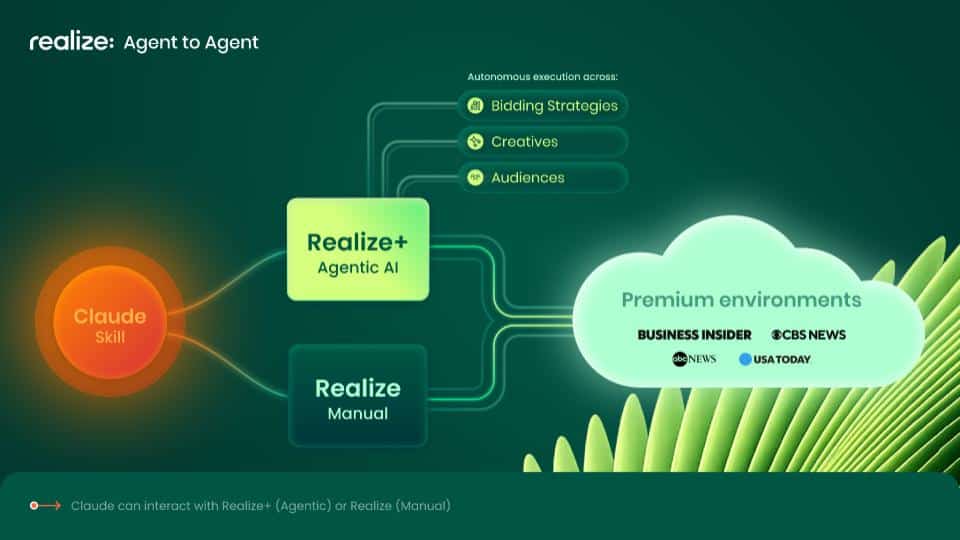
- Realize+ (Beta): This uses agentic AI to automate ad campaign management, continuously making and executing decisions regarding budget allocation, creative optimization, and targeting without requiring constant human intervention.
4 Best Practices for Transitioning to Agentic Ad Management
1. Start small
Don’t automate everything at once. Pick one channel to really get a feel for what the agent’s logic is before scaling.
2. Human-in-the-loop (HITL)
Use the agent to generate 1,000 variations, but keep a human in the mix to approve the core strategy and brand voice.
3. Establish clear guardrails
Define your maximum budget limits, target conversion boundaries, and strict brand exclusion rules inside the platform before launching. These guardrails keep the autonomous system operating within safe parameters.
4. Audit down-funnel performance regularly
Monitor the data downstream to ensure the conversions the AI is optimizing for are translating into real pipeline value and bottom-line revenue.
Overcoming Data Privacy and Security Concerns
Security is paramount when giving an AI the keys to your ad accounts. While granting access doesn’t mean your data is public, you still need to verify that your vendor is SOC 2 compliant, and has strict data retention policies to ensure your competitive data isn’t used to train models for other users.
Key Takeaways
The transition from button-pusher to system architect is the biggest shift in a media buyer’s career. By using AI agents, you eliminate the repetitive grind, stop wasting budget on human error, and finally have the time to focus on the high-level creative strategy that actually, and actively, gets attention.
Frequently Asked Questions (FAQs)
What is the difference between standard ad management software and AI advertising agents?
Standard software is a dashboard for manual use, while AI agents are autonomous systems that perceive data and execute changes via APIs, without you needing to click anything.
How do AI agents manage ad variations without losing brand consistency?
You train them on your guidelines. They generate the variations, but you can set up HITL checkpoints to review the work before it goes live.
Can AI agents manage ads across multiple networks at once?
Yes, and pretty easily. They integrate with APIs for Google, Meta, and others to move budgets and ads across platforms from a single interface.
Will AI agents replace human media buyers?
No, and this is a common misconception. They replace the repetitive work that humans are currently doing. Media buyers shift their focus to strategy and audience psychology while the agent handles the manual labor.


