
- Trend 1: The 2026 FIFA World Cup Will Redefine Global Sports Advertising
- Trend 2: Teams are Becoming Media Companies
- Trend 3: AI Is Powering Real-Time Personalization at Scale
- Trend 4: The Rise of Creator Ecosystems and Athlete-Led Media
- Trend 5: The Importance of Video Content and Livestreaming in Sports Marketing
- Trend 6: The Integration of E-commerce and Digital Experiences in Sports
- Trend 7: The Surge of Women’s Sports Fandom
- Key Takeaways
- Frequently Asked Questions (FAQs)
Today’s sports fans expect more than just highlights and final scores. They want access, personalization, and a greater connection to the teams and athletes they follow. And, they want all of this on their terms, across multiple platforms, and in real time. As a result, sports leagues and organizations are no longer just competing on the field, they’re competing for attention in a crowded digital landscape, where content, community, and experience might matter as much as performance.
In 2026, the most successful teams and brands are thinking like media companies, using AI to scale content and personalize it, and building direct relationships with fans rather than relying solely on third-party platforms. The following trends highlight how sports marketing is evolving, and where the biggest opportunities lie for digital advertisers.
What’s changed in our 2026 update:
– Five of the seven listed trends are new for this update; new trends added are:
- The 2026 FIFA World Cup Will Redefine Global Sports Advertising
- Teams Are Becoming Media Companies
- AI Is Powering Real-Time Personalization at Scale
- The Rise of Creator Ecosystems and Athlete-Led Media
- The Surge of Women’s Sports Fandom
– All entries include updated and current information, advice, and stats.
Trend 1: The 2026 FIFA World Cup Will Redefine Global Sports Advertising
The 2026 FIFA World Cup isn’t just another major sporting event — it’s set to become one of the largest global media moments in history. With matches located across the U.S., Canada, and Mexico, and an expanded 48-team format, the tournament is expected to reach a record-breaking global audience.
What will really set 2026 apart isn’t just the size of the audience, though, but the way it will engage. According to a WARC (World Advertising Research Center) study, FIFA has partnered with TikTok for the event, signing a “Preferred Platform” agreement that will grant creators “behind-the-scenes access and archive rights.” There have already been 1.4M TikTok posts using the #FIFAWorldCup hashtag, months before the event is due to begin. Additionally, per the study, 85% of fans use TikTok as a second screen during live events.
Even Netflix is getting in on the action, agreeing to stream Goalhanger’s popular “The Rest Is Football” podcast daily during the World Cup.
This expansion of content beyond the actual TV match coverage to the surrounding conversation on various media platforms will be unprecedented. Dan Holt, strategy partner, Havas Media Network, told the WARC that, “The World Cup match will be the base layer. Meaning will be assembled elsewhere, across social feeds, watch-alongs, creator commentary, group chats, memes, and remixes.”
For digital advertisers, this shift creates an opportunity to extend beyond traditional media buys and show up where the conversation is actually happening. Brands that can align their messaging with real-time moments, creator content, and second-screen behavior will be better positioned to capture attention throughout the entire fan experience, not just during the match itself.
Trend 2: Teams are Becoming Media Companies
In 2026, sports teams and leagues are no longer just the subjects of content; they’re full-fledged content creators. From behind-the-scenes footage and locker room access to player-led storytelling and documentary-style series, teams are using platforms like TikTok, YouTube, and Instagram to produce always-on content designed to engage fans beyond game day.
For example, FC Barcelona (@fcbarcelona) is using its TikTok account, which has over 65 million followers, to share exclusive footage of team practices, locker-room celebrations, and warm-up routines that fans don’t see during regular television broadcasts. Likewise, Formula 1’s TikTok account offers behind-the-scenes footage, including team radio clips, pit crew challenges, and casual driver interactions.
At the same time, community-building has become a core part of the playbook. Fans are gathering in Discord servers, Reddit forums, and other private groups to connect, debate, and rally around their favorite teams. These communities provide digital advertisers with a goldmine of insights, and they’re using them to their advantage by offering more interactive content and gamification, such as fantasy sports leagues, prediction games, and live trivia, where fans are rewarded for participating.
User-generated content is also playing a bigger role. The most effective advertising campaigns are encouraging fans to participate by sharing reactions, traditions, and moments. This turns passive viewers into active contributors.
In 2026, the goal isn’t just engagement, it’s ownership of attention and community.
Trend 3: AI Is Powering Real-Time Personalization at Scale
Personalization in sports marketing is no longer just about segmentation, it’s also about real-time decision-making that’s powered by AI. Sports teams and advertisers now have access to massive amounts of first-party data, from app usage and ticket purchases to viewing habits and in-game interactions. But, the real shift is in how that data is being used.
Consider what’s possible using AI-driven systems:
- Dynamic ticket pricing based on demand signals.
- Real-time content recommendations during live events.
- Personalized merchandise offers triggered by key moments.
- Automated cross-channel campaign optimization.
Instead of manually building campaigns, marketers can define the inputs and let their AI systems optimize the outputs, testing creative, adjusting messaging, and allocating ad spend in real time.
Predictive analytics is also becoming more actionable. Sports teams can now identify which fans are likely to attend games, upgrade their seats, or become season ticket holders. They can then tailor experiences accordingly.
As personalization becomes more sophisticated, though, so do expectations around privacy. Maintaining trust through transparent data practices remains critical.
Trend 4: The Rise of Creator Ecosystems and Athlete-Led Media
Source: YouGov
Influencer marketing has evolved into something much bigger in 2026. It’s now a creator-driven ecosystem where athletes, teams, and popular sports influencers all play a role. Major influencers can deliver authentic, trustworthy, and relatable content to highly engaged audiences across platforms such as TikTok, Instagram, and YouTube, boosting a sports brand’s reach and image. Even smaller influencers are in demand, with sports brands actively sourcing talent in communities like Reddit.
These aren’t one-off campaigns, either — they’re long-term collaborations that prioritize authenticity and consistency. This shift gives brands an opportunity to tap into existing fan trust, reach niche audiences through creator communities, and produce content that feels native, rather than promotional.
It also reflects a broader shift in how sports marketing campaigns are planned and executed. As Alex Henderson, sports sponsorship lead at M+C Saatchi Fluency, told Zappi, “Plan from cultural moments, not partnership menus. Don’t default to signage or social posts. Do the research to map the moments your audiences care about. Then design brand-led experiences that will deliver meaning in those moments.”
In this model, creators play a key role, helping brands show up in those moments in ways that feel timely, relevant, and authentic to fans.
To measure the impact of influencer marketing, digital advertisers can track engagement metrics like views and conversion rates. They can also measure engagement on emerging formats, such as livestream takeovers and exclusive fan Q&As on platforms like TikTok or Twitch.
Name, Image, and Likeness (NIL) rules are also changing the game in sports marketing. In 2021, the NCAA began allowing student-athletes to earn money from their personal brands. According to ESPN, top athletes have secured deals with brands such as Nike, Adidas, and Under Armour. Even non-sports brands, like T-Mobile and Amazon, have made deals with students.
- According to a 2025 Sprout Social survey, 86% of marketers from companies with over 100 employees expected to use influencer marketing during the year.
- According to data from FanZGo, athletes have an engagement rate of 5.6% on social platforms, compared with 2.4% for non-athlete influencers.
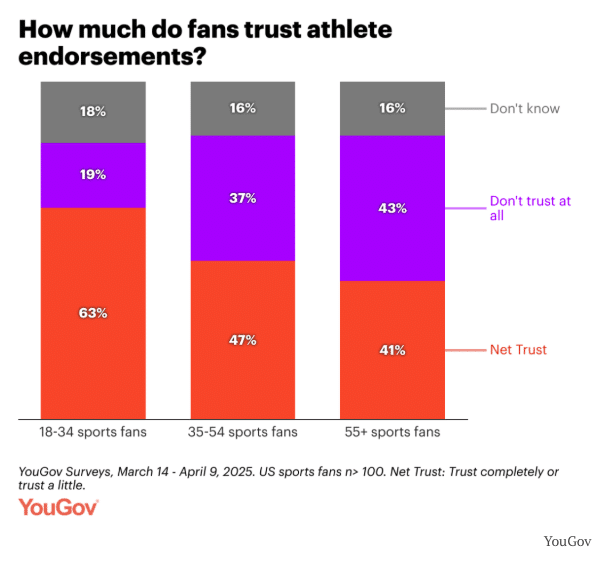
- 63% of fans between 18-34 trust athlete endorsements.
Trend 5: The Importance of Video Content and Livestreaming in Sports Marketing
Unsurprisingly, video is firmly established as the primary medium of digital sports marketing. But while the way people consume sports content on video is evolving, high-quality content remains a non-negotiable if you want to hold fans’ attention. Fans want to see more than just game action or final scores: They’re looking for visual storytelling that brings them closer to the athletes.
To accomplish this, brands are livestreaming not just games, but behind-the-scenes access, press conferences, and training camp sessions. As mentioned, sports marketers are also using short-form video platforms, such as TikTok or YouTube Shorts, which are well-suited for reaching younger audiences.
If you’re creating video content for different digital channels, such as short-form, make sure you optimize each piece for the respective platform. For example, use captions where applicable to enable silent viewing, along with quick, attention-grabbing intros on social.
In addition to livestreaming, interactive video is also on the rise in sports marketing. Fans now have the option of choose-your-own-view cameras and real-time polls, while clickable stats overlays are often available during livestreams.
- According to Adwave, approximately 70% of fans now watch sports via streaming platforms.
- Amazon is the most used platform for streaming sports, garnering 65% of respondents in a 2025 Performance Research survey (reported by the Sports Business Journal).
- 48% of fans say that streaming makes them feel more connected to their favorite teams and sports, per the same survey.
Trend 6: The Integration of E-commerce and Digital Experiences in Sports
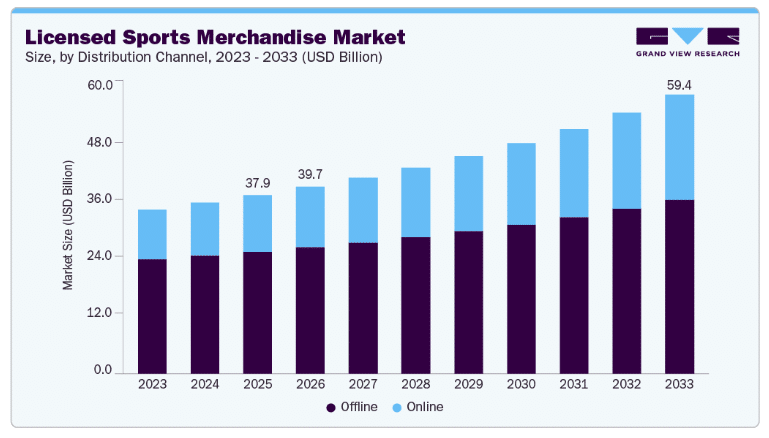
In 2026, sports fans are connecting with their favorite teams online more than ever. In fact, the licensed sports merchandise market is expected to grow at a compound annual growth rate (CAGR) of 6.1% until 2033. Professional sports teams and leagues are responding to the demand by doubling down on e-commerce to boost revenues from licensed sports merchandise.
(Source: Grand View Research)
AI is playing a key role in this evolution. Teams can now deliver personalized product recommendations and trigger merchandise drops based on real-time moments, like a major trade or a championship win.
Digital platforms are enabling fans to have virtual experiences that bring them closer to the action. For example, NBA fans who own a Meta Quest VR headset can watch NBA games in virtual reality.
When it comes to getting into live games, mobile ticketing is now the standard. These digital passes can be bundled with personalized perks, in-seat ordering, and even in-game entertainment, like polls and trivia.
- The licensed sports merchandise market size was over $37 billion USD in 2025.
- The market size is projected to grow to $59.4 billion by 2033, per the same report.
While digital collectibles, including NFTs, and limited-edition content still exist as niche engagement tools, the bigger shift is toward seamless, end-to-end digital ecosystems that connect content, commerce, and live experiences.
In 2026, the most successful sports organizations aren’t just selling merchandise, they’re building integrated digital experiences that turn moments of fandom into measurable revenue.
Trend 7: The Surge of Women’s Sports Fandom
Women’s sports are no longer a niche category in 2026. In fact, they’ve become one of the fastest-growing segments in the entire sports landscape. Recent data from an L.E.K. Consulting Sports Survey shows that engagement is accelerating across key demographics. Overall, women saw an 8% increase in sports engagement, signaling a broader shift in who participates in sports fandom.
At the league level, the growth is even more striking. The WNBA led all major leagues with a 65% year-over-year increase in avid fandom, outperforming traditional powerhouses and highlighting a meaningful change in fan behavior.
This momentum is being driven by a combination of factors, including the quality of play, the rise of high-profile athletes like Caitlin Clark, and a growing cultural emphasis on representation and equity in sports. Star players are also playing a major role in expanding visibility and engagement, with breakout moments translating directly into increased viewership and media value.
Importantly, this isn’t a short-term spike. Fans expect their engagement with women’s sports to continue growing, with a net 14% increase in anticipated viewing time over the next 12 months. For marketers and advertisers, this presents a major opportunity. Women’s sports audiences tend to be younger, more diverse, and highly engaged, making them especially valuable for brands looking to build long-term relationships with emerging fan segments. In 2026, the only question around women’s sports is how quickly brands can adapt to keep up with their growth.
Key Takeaways
Fan expectations have never been higher. As a result, sports marketing campaigns need to drive community engagement, deliver personalized content, leverage influencer partnerships, feature immersive video, and deliver seamless e-commerce experiences to be successful in 2026. Not surprisingly, data plays an important role. At the same time, new formats and livestream takeovers are providing sports organizations with new revenue streams and an opportunity to increase fan loyalty. Marketers who can make fans feel like they’re a part of something bigger will increase their chances of success.
Frequently Asked Questions (FAQs)
What are the most effective digital advertising channels for sports marketing in 2026?
Short-form video engagement is becoming more critical in 2026. As a result, sports marketers must include platforms like TikTok and Instagram in their marketing strategies. YouTube works well for long-form content and livestreams, and emerging platforms like Discord and Threads are becoming prime locations for community-building.
How can sports brands measure the ROI of their digital marketing efforts?
Sports brands should track key KPIs, including CTR, video view rates, branded search lift, social engagement, merchandise conversion rates, and fan lifetime value (LTV).
How is technology (e.g., VR, AR) impacting sports marketing?
Sports marketers are using AR/VR technology to enhance fan engagement in 2026. This includes producing virtual events, gamified content, and fully immersive in-stadium experiences. For example, fans can use VR headsets like Meta Quest to watch games courtside from the comfort of their own homes, while teams are starting to offer in-app AR features that let players try on jerseys or interact with polls and trivia during games.
What are the key metrics for measuring success in sports digital marketing?
Sports marketers can measure success through several key metrics, including social media engagement rates, video views, CTRs, and conversion rates for various campaigns, including ticket and merchandise sales, or app downloads.


