
Every marketer I know is racing to adopt AI, and they are right to. Still, if that’s all they are doing, it probably won’t save their jobs.
When a survey of 200 performance marketers finds that 98% are already using or testing agentic AI, the obvious conclusion is that the technology is now table stakes. If your AI stack is what you’re betting on to set you apart, you may have have already lost, because other marketers are already running a similar stack against a lot of the same data, and likely getting similar answers.
So if intelligence is no longer as scarce, what is? The answer is the thing AI cannot hand you: the nerve to make a move before you’re certain. Most marketers do not have the courage to do that. That nerve is the most valuable thing AI unlocks for a marketer right now, and almost no one is using it that way. I made this case on stage at OMR, and the full talk is below.
We’ve spent years trying to analyze our way to certainty, and that instinct, the one that feels like rigor, could be holding us in the middle of the pack with everyone else. Marketing does not have an intelligence problem anymore. It has a courage problem.
Why we almost didn’t make our bravest campaign
Recently my team built a campaign around an animated fox. A few years ago a swing like that would have cost us hundreds of thousands of dollars and weeks of production. AI made it cheaper and faster, and that is the part everyone notices. But that’s not what matters; what matters is that two years ago we would not have made the fox at all.
Without AI, the risk of a creative bet that size was too high to justify. In the AI era, we were able to look at five strong directions, choose one, ship it in weeks, and know we could change course quickly if the creative didn’t work. When the cost of a wrong answer drops that far, a bet that used to be reckless becomes reasonable.
That is my whole argument in one campaign. AI did not make us smarter than our competitors, who have the same tools we do. It made us braver than we could afford to be before. The question is whether you will have the courage to use it the same way.
When everyone has the same intelligence, no one has an edge
Think about a fish market like the three hundred year old one in Hamburg, where OMR is held. If one chef always knew which fish was undervalued that morning, or about to be in season, they could show up early, buy it cheap, and turn it into the special that made the night. That edge belonged to whoever knew something the other buyers did not.
Now give every buyer in that market an AI fish market assistant that scans every stall, reads every recipe, and tells all of them what the overlooked fish is really worth. Instantly, prices snap to perfect. The chef who used to have an edge no longer does, because knowledge is now much more evenly distributed across the market. Marketing is in the same situation. The advantage always came from having information others lacked, and universal AI strips that asymmetry out. Being well-informed stops being a differentiator and becomes the price of entry.
Taboola sees tens of thousands of Realize advertisers running hundreds of thousands of campaigns across the majority of the open web, which is enough data to watch the shape of performance change over time. In 2023, the spread between high and low performers was wide. Strong performers pulled well ahead, weak ones fell well behind. In finance, that distance is called “Alpha”, the return generated above the market average, and it is what a marketer’s skill is actually worth. Two years later that distance has roughly halved.
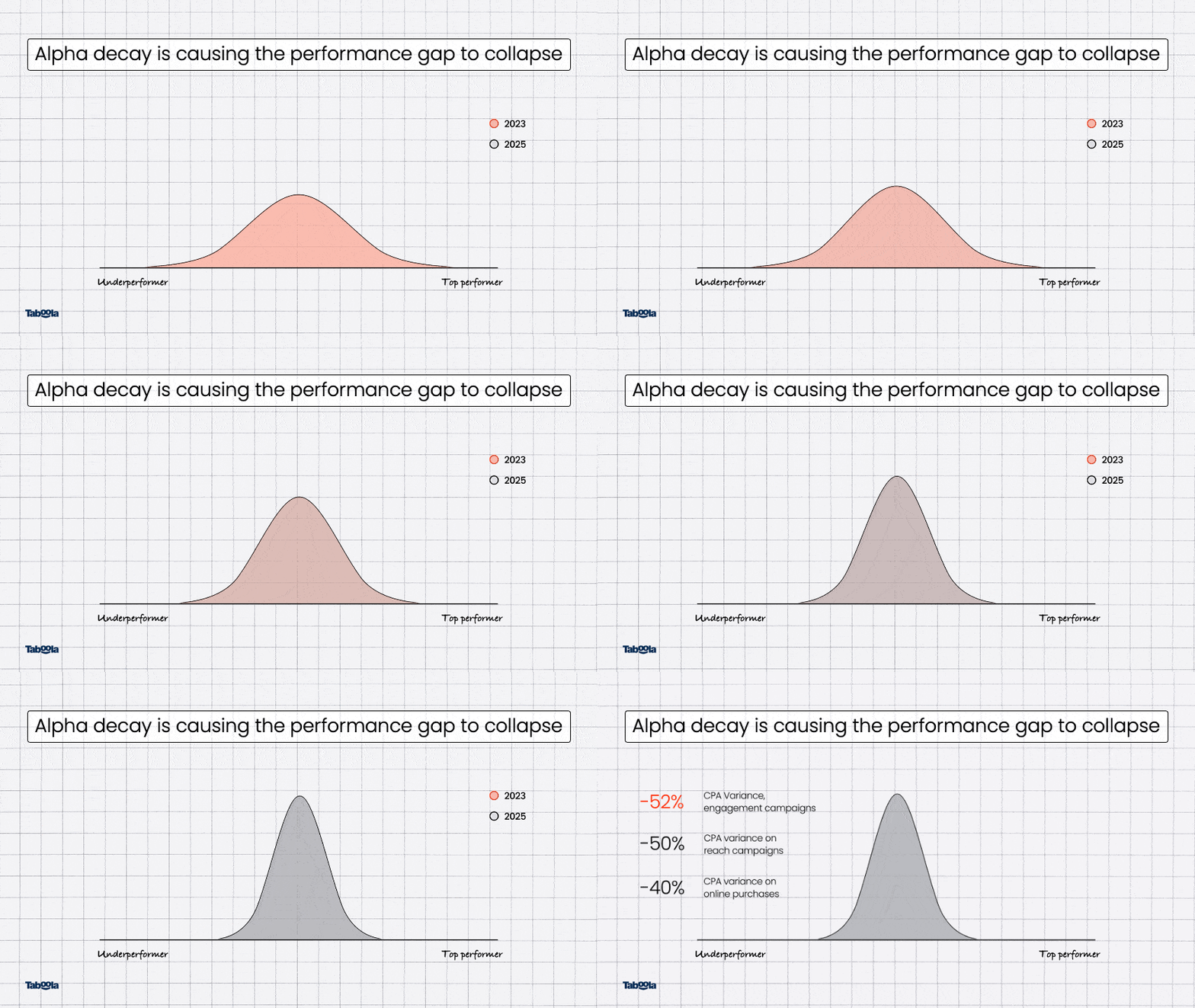
Cost-per-action variance fell 52% on engagement campaigns, 50% on reach, and 40% on campaigns optimizing for online purchases. AI lifts the floor, so the weakest campaigns are no longer as weak. But the same force that raises the floor lowers the ceiling, because tactics that are easy for you to optimize are easy for everyone else to optimize too. The curve gets tall and narrow, the middle swallows almost everyone. Standing out gets harder every quarter!
Average is no longer a safe place to stand. When AI is doing most of the visible work and your results sit exactly where everyone else’s sit, the question a CFO starts asking is whether you are necessary to just get to average. A team that produces average output with tools available to everyone seems like a team a few more agents could replace.
The brands beating the average run courage as a system
The question, then, is how to get out of the middle. I spent time with the advertisers on our platform who are still pulling ahead, because I wanted to understand what they had that the middle did not. They are brands you would recognize, across insurance, credit cards, home improvement, and health and wellness.
What they have in common is courage, built into how they operate. In one company it takes the form of a single master metric they hold every activation against, which lets them test fast and decide faster. In another it is a standing “test target” for how many new channels and strategies they will try each year, which they hit relentlessly. In another it is a bias toward momentum, weighed going behind anything that shows early promise and a willingness to judge it quickly. The common thread is that they would rather lose money on a pilot that fails than lose an opportunity they believed had even a coin-flip chance of working.
To be clear, recklessness is not the goal. What separates these brands is a repeatable method for finding the next thing that works, one they believe in and, just as important, one they can get a CFO to fund. That system cannot just be more analysis, which is the part that holds most teams back. You can not analyze risk away, or you will lose your shirt in the casino.
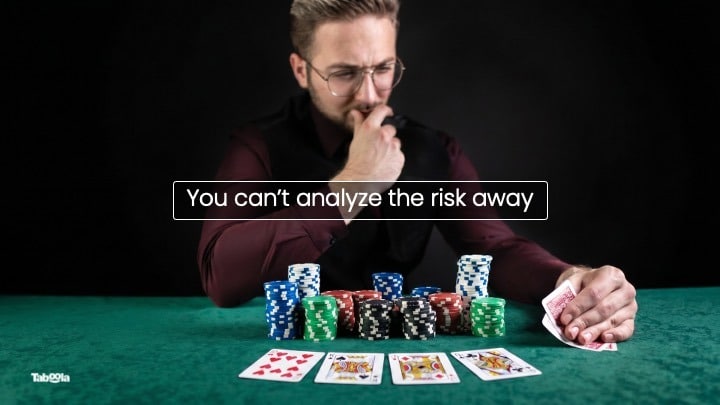
When marketers feel uncertain, the instinct is more data, another test, a better attribution model. The instinct feels like diligence, and in moderation it is. It is also how everyone ends up bidding on the same fish, because similar analysis run on similar AI produces similar conclusions and converges on the same moves. But by the time analysis delivers certainty, the opportunity has usually closed. The brands that win accept this, place their bets without certainty, and build something that lets them act anyway.
Marketers should treat their bets like an investment portfolio
A system I’ve come to adopt, that recognizes that you can’t analyze your way to always winning, looks like an investment portfolio. A portfolio is not any diverse enough assortment of tactics. It is a deliberate mix in which some positions are expected to lose. If every line is expected to return positively, it is not a portfolio, it is a list of safe bets, and safe bets are exactly where alpha decay does the most damage. It has two halves.
- Exploit is the proven work, the channels where the math is known and the history is long. It’s the majority of the budget, and the foundation that keeps a budget from collapsing. It is also the most crowded, because what is reliable for you is reliable for your competitors, so exploit’s job is to enable the flexibility to do the “explore” portion.
- Explore is the new strategies, the emerging channels, and the wild cards that may fail outright. Some of these positions will lose by design. The ones that work are where alpha now lives, the outsized return a CFO cannot recreate with another agent. No one outperforms by getting marginally better at what everyone is getting marginally better at. The outperformance comes from explore, funded by the discipline of exploit.
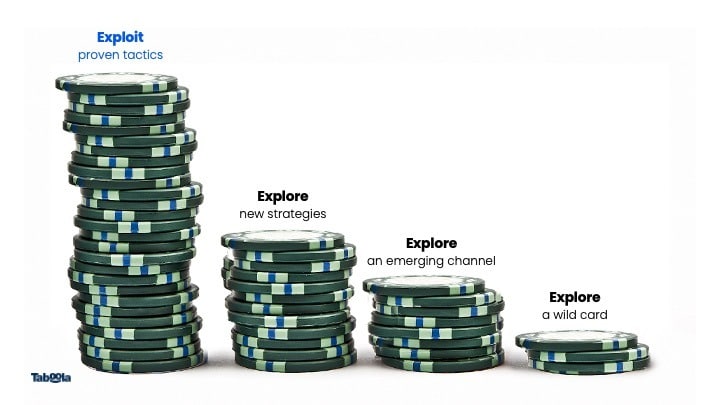
AI contributes to each portion differently. On the exploit side, AI is the autopilot. These are the known environments where it has data and history and genuinely runs the optimization better than a person can, so the right move is to automate that work. On the explore side, AI is a copilot rather than a pilot. It will not name the bet to take. What it does is collapse the cost and time of taking one.
Three moves for courageous marketers: build, bet, and own the result
Courage only changes anything when it changes what a team actually does, and that comes down to three decisions every marketing leader is already making, most of them by default. Make them on purpose and you have a system, but leave them to drift and you have the average.
The first is to create a system. Most marketing teams operate on a collection of tactics. A team built to outperform the average decides on a system they believe in. For example, to run on a portfolio, with a deliberate split between the proven work and outside bets. A budget you never consciously divided to account for risk is a year of spending you will have to rationalize after the fact.
The second is who makes the call. AI will give you more clarity than any marketer has ever had, and it will still refuse to place the bet, because it has no style, no accountability, and no team it believes in. You do and the decision should rest on human grounds. Holding out for the number that erases all doubt is not diligence, it is how you arrive after the opening has closed.
The third is how you answer for the result. Marketing is not a cost center. It is a business that takes capital and returns revenue a CEO and a CFO can see, and a business that beats its plan earns the right to reinvest. If your teams overachieve, make the case for more exploration and spend it there. That is the difference between a line item, which gets cut in the first hard quarter, and a function that compounds, which does not.
These three decisions are the work AI cannot do for you, and it is the only work left that still separates one marketing team from another.
The era of AI will reward the brave
AI is coming for the marketer who hides behind analysis, optimizes the obvious, and waits for certainty before moving. That marketer is already being replaced, because everything they do can now be done by the tools sitting on every desk.
It is not coming for the marketer who takes risks inside an intentional system. That marketer is harder to replace than two years ago, not easier, because beating the average has become genuinely difficult, and the people who can still do it are rare.
The era of AI will reward the brave.
The question is if you choose to be.


