
- Performance Marketing vs. Brand Marketing in the AI Era
- The Trap of the “Big 2” Walled Gardens
- Pain Point 1: The Daily Grind of Campaign Maintenance
- Pain Point 2: Creative Production Bottlenecks and Ad Fatigue
- Pain Point 3: Fragmented Data and Reporting Chaos
- Core Channels Driving Modern Performance Campaigns
- Essential Performance Metrics and KPIs for 2026
- Key Takeaways
- Frequently Asked Questions (FAQs)
Not long ago, performance marketing was simply launching ads, tracking clicks, and manually optimizing bids to scale. In 2026, that’s no longer the case. Today, advertisers can find themselves stuck inside the closed ecosystems of the “Big 2”: Google and Meta. A May 2026 survey of 200 senior performance marketers makes this dependency concrete: 74% allocate more than a quarter of their entire budget to Paid Search, and 67% do the same for Paid Social — a level of concentration that makes diversification feel structurally impossible, not merely strategically inconvenient. It’s a situation that can come with fragmented data, burned-out ad managers, and the relentless daily updates that define manual campaign management.
The Agentic Advantage in Performance Marketing Report 2026
The brands moving out of this grind aren’t working harder, but smarter. They’re handing off the heavy lifting to agentic AI marketing platforms that operate as autonomous copilots, leaving teams free to focus on strategy that actually moves the needle.
Performance Marketing vs. Brand Marketing in the AI Era
Before we explore where modern performance marketing is going, it’s important to distinguish what makes this different from traditional brand marketing, and how the line between them is becoming increasingly blurred. Brand marketing plays a long game, building recognition, trust, and emotional resonance over time. Performance marketing, by contrast, has traditionally been about immediate, measurable outcomes like clicks, conversions, cost per acquisition, and return on ad spend (ROAS).
In 2026, though, the most competitive advertisers have stopped treating these as separate disciplines. Performance marketing in 2026 is defined by a hybrid model: full-funnel strategies that combine precision performance tactics with brand-building storytelling, all measured against tangible business outcomes. Artificial intelligence (AI) is what makes this possible at scale, enabling granular optimization at the conversion level while informing upper-funnel creative decisions based on predictive data. Performance and brand marketing have merged into a single, continuous growth system.
The Trap of the “Big 2” Walled Gardens
Google and Meta remain non-negotiable pillars of most paid media strategies. But, for all the reach they offer, operating exclusively within the Big 2 walled gardens comes with a growing set of friction points that no amount of budget can outspend.
Each platform has built its own native automation tools, such as Google’s Smart Bidding and Performance Max (PMax) and Meta’s Advantage+, but these tools come with a catch. They optimize within their own ecosystems, for their own metrics, with minimal transparency into the decisions being made. Data from Google stays in Google, and data from Meta stays in Meta, making cross-platform intelligence nearly impossible to assemble without significant manual effort.
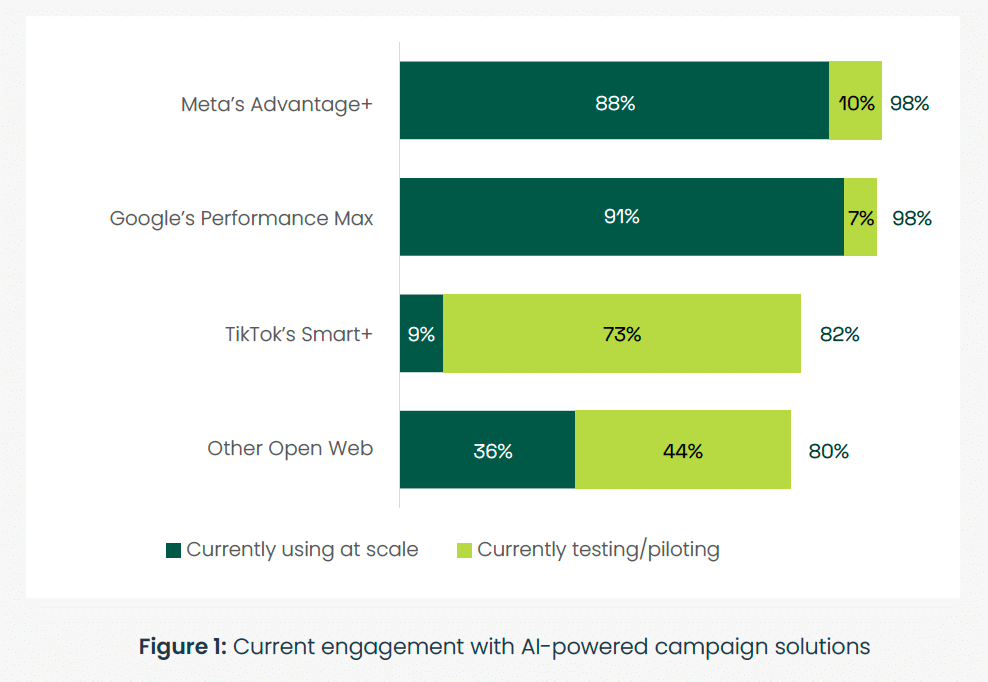
These are not niche tools being cautiously piloted by early adopters, either: The same survey found that 91% are currently running Google PMax at scale, and 88% are running Meta Advantage+ at scale. The industry did not trial these platforms — it moved to them wholesale, and fast, because performance outcomes validated the investment early.
Again, though, scale of adoption does not mean absence of limitation, and the result is that brands are technically running “automated” campaigns but still spending large amounts of human time managing them. True automation that actually reduces workload and improves outcomes requires something that sits above these platforms, not inside them.
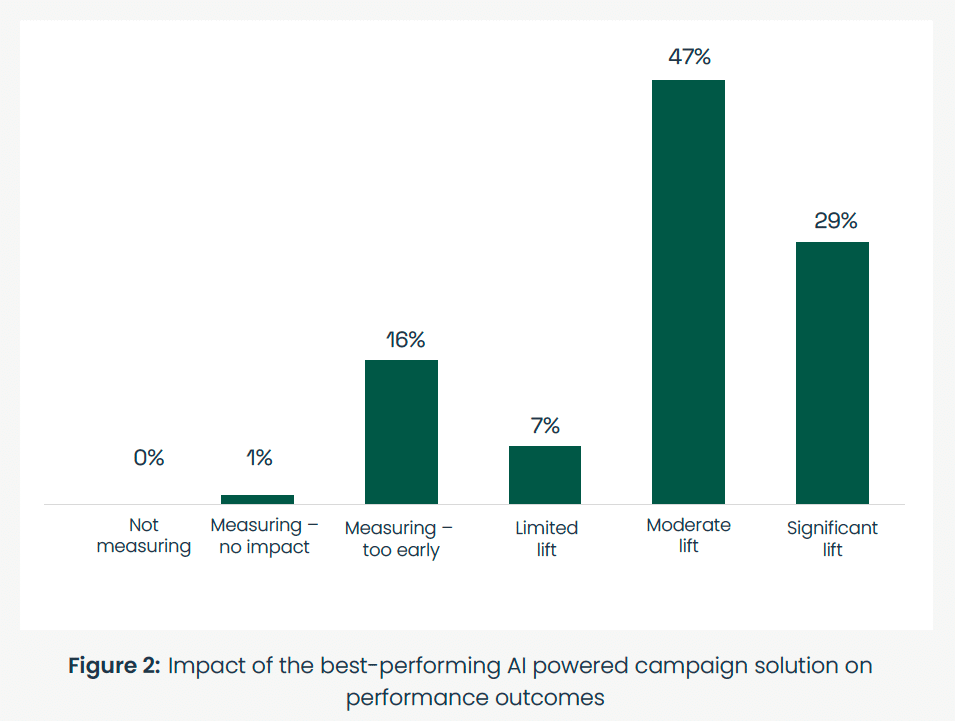
The performance data underscores why getting this right matters. The survey found that 76% of marketers using their best-performing AI-powered platform are seeing meaningful improvements in performance, with 29% reporting significant lift and 47% reporting moderate lift. That proof of performance is what drove adoption to near-total penetration in search and social, and it’s the same standard the rest of the channel landscape is now being measured against.
Pain Point 1: The Daily Grind of Campaign Maintenance
Ask any media buyer what their day looks like, and the answer is usually the same: an exhausting rotation of downloading reports, diagnosing performance dips, tweaking bids, moving budgets, and putting out fires, before starting the whole cycle over again tomorrow. This is the campaign maintenance grind, and it’s one of the most persistent and costly inefficiencies in modern advertising.
The Bottleneck of Media Execution
Studies and firsthand accounts from performance teams consistently point to the same reality: that media buyers spend the vast majority of their time (some estimate as much as 90%) on routine execution tasks — pulling search term reports, adjusting negative keyword lists, moving budget between ad groups, responding to quality score fluctuations. These are not high-value strategic decisions but maintenance tasks that happen to require a human because the platforms haven’t made them truly autonomous.
The problem isn’t only wasted time, it’s that this constant context-switching prevents teams from doing the work that actually differentiates a brand, like crafting compelling narratives, testing bold new creative directions, identifying emerging audience behaviors, and building the channel strategies that drive long-term growth.
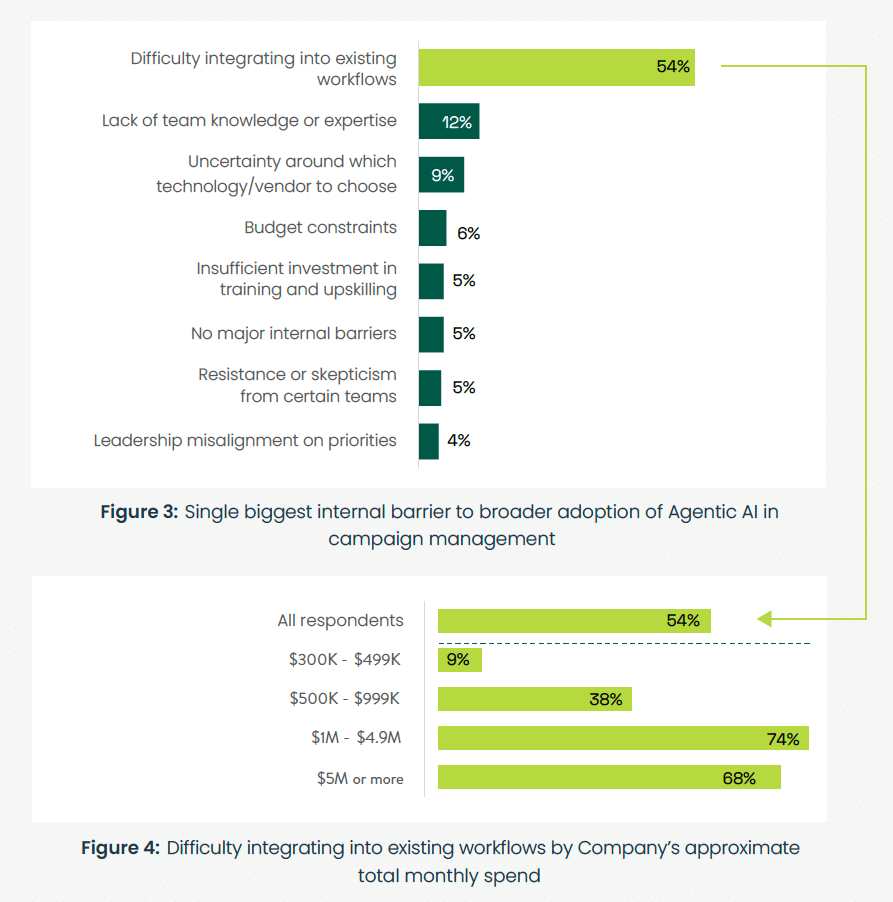
The scale of this challenge only grows with the size of the operation. The survey referenced above found that 54% cite difficulty integrating AI solutions into existing workflows as their single biggest internal barrier to broader agentic adoption. That’s a figure that rises sharply with budget size, reaching 74% among organizations spending between $1M and $4.9M per month, and 68% among those spending $5M or more. The maintenance grind persists not because teams lack the will to automate, but because fitting autonomous systems into complex, established operations is itself a significant undertaking.
The Solution: Agentic AI as Your Copilot
This is what autonomous media execution powered by agentic AI is designed to solve. Unlike traditional rule-based automation, which requires humans to define every condition and threshold in advance, an AI marketing copilot operates with real autonomy. It monitors performance in real time, identifies anomalies, executes mid-flight adjustments, and applies optimizations proactively, without waiting for a human to notice and respond.
The shift isn’t about replacing media buyers, but redirecting them. When AI handles the maintenance, human expertise can be applied where it creates disproportionate value, in strategy, creative direction, and growth planning.
Pain Point 2: Creative Production Bottlenecks and Ad Fatigue
Creative is the single biggest needle-mover in performance advertising. Targeting and bidding have been largely commoditized by platform automation, but a compelling creative is still a competitive advantage. The problem? Creating enough of it, fast enough, is becoming increasingly untenable for most teams.
The Insane Workload of Modern Creative
Creative production bottlenecks are a growing crisis in performance marketing. Ad fatigue — the rapid decline in performance as an audience sees the same creative repeatedly — now sets in faster than ever. Attention spans are shorter, platform feeds move faster, and consumers have become experts at tuning out anything that feels repetitive or formulaic.
On top of that, modern campaigns require creative at a scale that would have been impossible a few years ago. Different aspect ratios for different placements. Localized variations for franchise or regional campaigns. Platform-specific formats. A/B test permutations. What used to require a single designer for a single campaign now demands either a small team, or a fundamentally different approach to production.
The Solution: The AI Creative Lab
Agentic AI reframes creative production entirely. Rather than treating each new creative variation as a bespoke project, an AI creative system functions as a continuous generation engine, analyzing which elements (like headlines, visuals, formats, hooks) are driving performance, and creating new variations informed by that data automatically.
When the system detects performance reduction on a creative, it doesn’t wait for a human to notice and notify a designer. It identifies the winning structural elements, generates fresh variations, and routes them into rotation, keeping the creative pipeline perpetually stocked without adding additional work.
Pain Point 3: Fragmented Data and Reporting Chaos
The promise of data-driven marketing has always been in knowing what’s working, cutting what isn’t, and investing with confidence. In practice, most performance teams are living a very different reality.
The 10-Hour Manual Reporting Headache
Fragmented marketing data is one of the most universally cited frustrations among media buyers and marketing leaders. Google has its data. Meta has its data. TikTok has its data. Each platform applies its own attribution windows, uses its own conversion definitions, and reports through its own interface. Putting these data streams into a single, coherent picture of performance typically requires hours of manual export, reconciliation, and interpretation every week — time that is both costly and error-prone.
The downstream consequences are significant. Decisions get made on stale data, cross-channel interactions go undetected, and budget allocation is based on siloed platform metrics rather than true business impact. By the time a comprehensive report arrives at a stakeholder meeting, it’s already describing last week’s reality.
The Solution: Unified Agentic Analytics
Automated campaign management powered by agentic AI works at both the execution and intelligence level. A true agentic analytics system doesn’t only aggregate data from across platforms but also interprets it. It surfaces the signal within the noise, identifies cross-channel patterns that wouldn’t be visible in any single platform view, and delivers actionable narratives. The result is a shift from reactive reporting to proactive intelligence. Instead of explaining last week’s results, teams can act on insights in real time.
Core Channels Driving Modern Performance Campaigns
A complete performance strategy in 2026 spans a diverse and growing channel mix, from paid search and paid social to affiliate marketing and native advertising, and an expanding set of AI-led discovery environments where brands can appear in AI-generated recommendations and interfaces before a consumer ever opens a traditional search engine.
Each channel has its own bidding logic, creative requirements, audience targeting mechanics, and attribution methodology. Managing even two or three of these channels in parallel is a significant operational undertaking. Managing all of them, with the frequency and responsiveness that modern performance demands, is effectively impossible without autonomous support. This is where agentic AI starts being an operational necessity.
Consider, too, that not all channels are at the same stage of agentic maturity. According to the same survey, the channel landscape is effectively tiered. Google and Meta sit at the top as fully at-scale agentic environments, with 91% and 88% adoption respectively. TikTok Smart+ is in wide testing — 73% of marketers are actively piloting it with only 9% currently at scale, making it the next platform most likely to cross the adoption threshold. The Open Web sits at a different inflection point entirely: 44% of marketers are in active pilots and 36% are operating at scale, while 82% of organizations see AI-powered goal-based buying on the Open Web as a meaningful growth opportunity — the widest gap between intent and execution in the current channel mix.
Essential Performance Metrics and KPIs for 2026
The metrics that define performance marketing success haven’t changed fundamentally. Return on ad spend (ROAS), customer acquisition cost (CAC), lifetime value (LTV), conversion rate (CVR), and cost per click (CPC) remain the core. What has changed is how these metrics are measured, interpreted, and acted on.
Manual measurement like pulling numbers, building spreadsheets, and running calculations is increasingly a bottleneck rather than a routine. The speed at which campaigns can change, and the volume of signals being generated across channels, has outpaced what human analysis can process in time to be useful.
Smart performance teams are supplementing or replacing manual key performance indicator (KPI) tracking with predictive analytics managed by AI agents, which can model not just current performance but likely future outcomes, flagging underperformance before it becomes a problem and highlighting optimization opportunities before they close.
Key Takeaways
The through-line here that connects every pain point is the same: the tools that made performance marketing manageable in 2022 are no longer adequate for the complexity of 2026. The volume of data is too high, the speed of creative decay is too fast, and the fragmentation across platforms is too severe. The strategic dimension is equally stark. The survey found that 75% of marketing leaders rate finding a performance channel that delivers incremental outcomes beyond search and social as very or extremely important — a figure that rises to 70% rating it “extremely important” among those spending $5M or more per month. The performance marketing model is not just operationally strained; it is strategically over-indexed on two saturated channels, and the people with the most budget and decision-making authority are the most acutely aware of it. Manual workflows, however effective the team executing them, cannot keep up.
Realize+, the agentic layer of Realize performance platform, currently in beta, can help solve the pain points that come with walled garden advertising and bring the performance power of Google PMax and Meta Advantage+ to the open web. Rather than simply automating tasks, Realize+ functions as your autonomous campaign agent. That means you’ll benefit from continuous decision-making, execution, and adaptive strategies in real time using first-party data signals.
For advertisers who have been constrained by the agentic AI-driven walled garden environment, Realize+ offers a third option, one that delivers closed-loop performance optimization across premium open web publishers, without platform bias.
The shift to agentic AI is a fundamental change in operating model, from marketers-as-operators to marketers-as-strategists, with autonomous AI systems handling the execution layer. The teams embracing this model are getting back both the time and cognitive bandwidth to focus on what actually differentiates a brand — sharp strategy, compelling creative vision, and a deep understanding of the customer journey.
Frequently Asked Questions (FAQs)
What is modern performance marketing?
Performance marketing means spending ad dollars against outcomes you can actually measure, like sales, leads, sign-ups, and revenue. What’s changed is how those outcomes are achieved. In 2026, teams have moved beyond manual bid tweaks and last-click attribution. Today’s performance marketers blend predictive AI, full-funnel creative strategy, and cross-channel orchestration into a single growth engine built for speed and accountability.
What are the “Big 2” walled gardens?
Google and Meta. The walled garden refers to how tightly each platform controls its own data, tools, and reporting. You can run ads inside them, but you can’t easily see across them. Their built-in automation features optimize for in-platform metrics with limited transparency.
How does agentic AI solve ad fatigue?
For those looking for ad fatigue solutions, agentic AI turns ad fatigue from a production problem into a data problem. Instead of briefing designers every time performance dips, the system watches for decay signals, identifies which creative elements are still resonating, and automatically builds and deploys new variations. The pipeline stays fresh without the team needing to keep up.
Why is manual campaign maintenance a bottleneck?
Platforms themselves haven’t made routine tasks hands-off. Someone still has to pull the search term reports, catch the underperforming ad groups, move the budgets, and respond when something breaks. That work isn’t strategic, but it’s ongoing. When media buyers are stuck in daily upkeep, there’s no time left to think about where the brand should be going next.


